

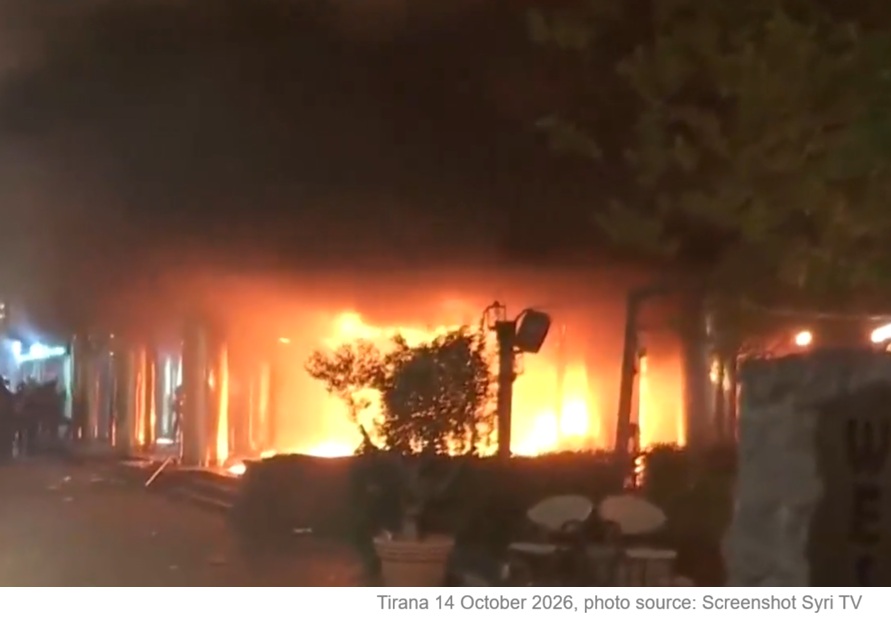
Tirana, 15 October 2026, dtt-net.com – Albania is facing a serious escalation of political and social tensions. The student protests of October 13 and 14, 2026, accompanied by violent clashes, damage and attacks on state institutions, have opened a new phase in an anti-government movement that has continued for more than four months. Over the two days, central Tirana was marked by barricades, fires, tear gas, interventions by special police units and attacks on public buildings, at times taking on the appearance of a violent confrontation zone.
The immediate context of this crisis is the “Flamingo Revolution,” which began on May 31, 2026, in opposition to a tourism project in the protected area of Zvërnec. Over the following 130-plus days, the largely peaceful demonstrations expanded their agenda from environmental protection and objections to the approval process for strategic investments to corruption, political accountability, the model of governance and demands for the resignation of Prime Minister Edi Rama. The involvement of students in mid-October has changed the movement’s social weight, pace and profile.
The student protests began with concerns about higher education and young people’s prospects, but have now acquired an explicit political objective: the departure of the prime minister and his government. This distinguishes the current movement from conventional protests over university fees and study conditions. The situation must be understood simultaneously as a crisis of public order, political representation and public trust in institutions.
The Dynamics of the October 13–14 Protests
On October 13, students gathered outside the Ministry of Education in Tirana. The demonstration escalated after stones and other hard objects were thrown at the building and clashes erupted with police. Demonstrators spread to Skanderbeg Square, Durrës Street, Kavaja Street and other areas, where barricades were erected, rubbish bins were set on fire, and public and private property was damaged, including City Hall. Despite police interventions, groups of protesters repeatedly regrouped, and clashes continued into the evening.
A particularly troubling aspect was the manner of police intervention. Footage showing protesters beaten with batons, dragged along the ground and subjected to rough treatment during detention, including in circumstances where some individuals posed no immediate threat, revealed unacceptable conduct and raised serious questions about proportionality and professionalism. The case of a 19-year-old with a broken leg who was handled carelessly by officers heightened concern. Repeated use of tear gas also affected people who were not involved in the clashes. These incidents cannot be justified by violence committed by other individuals at the protest.
The initial toll included more than 50 people taken into police custody and 27 who received medical treatment, among them students, police officers, journalists, passersby and a foreign diplomat who sustained a head injury. Seven people were still receiving treatment at the Trauma Hospital on the morning of October 14, none in life-threatening condition. These figures reflect the initial phase and do not constitute a final count of incidents across the two days.
On October 14, the confrontation escalated markedly. After demonstrations resumed near the Ministry of Education, where the entrance, security cameras and parts of the building were damaged and fires were started, groups of protesters moved toward central state institutions. The Prime Minister’s Office was attacked, and objects and trees within its perimeter caught fire. At the offices of the Presidency of Parliament, protesters forced open the main entrance and some entered the building; a fire was also started near the entrance. Attacks and attempted arson also targeted the Ministry of Justice. Commercial premises were damaged, and further flashpoints emerged across central Tirana.
The attacks on the Prime Minister’s Office, parliamentary offices and ministries marked a qualitative escalation: the targets were no longer merely police barriers but the buildings and symbols of state power. Nevertheless, responsibility for arson and damage must be attributed to those who committed the acts, not to all students or citizens who took part in the protests. Distinguishing peaceful protest from violent conduct is essential to a fair assessment of the events.
Student Demands and the Political Character of the Movement
Initially, students raised issues concerning university fees and conditions, education funding, the quality of studies and employment prospects. The demand now dominating the protests, however, is not a package of educational reforms. Organizers have stated that they are not seeking sector-specific negotiations with the Ministry of Education but the resignation of Prime Minister Edi Rama and the departure of the government.
This demand coincides with the main objective of the movement that began on May 31. The “Flamingo Revolution” has also called for a transitional technocratic government, free and fair elections, the cancellation of the contested Zvërnec project and changes to the legal framework governing protected areas and strategic investments. These are elements of the broader civic platform and should not automatically be presented as demands unanimously endorsed by all students.
The involvement of the parliamentary opposition increases the political significance of the protests but also raises the question of how far the organizers will maintain their independence from political parties. The combination of demands for political change with the mobilization of a younger generation makes the protests potentially more consequential than a dispute over education.
Response of the Government and State Institutions
The government’s response has focused on condemning violent acts, protecting institutions and prosecuting those responsible. At the time this report was prepared, no direct public response by Prime Minister Rama to the central demand for his resignation had been identified. Deputy Prime Minister Albana Koçiu condemned vandalism and urged students to distance themselves from violence. In a statement on October 14, Interior Minister Ervin Demo accused the country’s longstanding political opposition of exploiting student grievances to foment destruction and unrest. He also alleged involvement by “malicious foreign hands,” which, he said, had operated through social media since June, but offered no specific public evidence in the statement to substantiate this claim. Demo characterized the violence as part of an organized scenario, warned those responsible for arson and destruction that they would face individual criminal accountability, and praised the professionalism of the police. At the same time, he urged students to choose dialogue with the government, referring to the Pact for the University. This interpretation of events contrasts with concerns over excessive force by police officers; both the allegation of foreign interference and responsibility for violence require independent verification.
Police announced the suspension of four officers and the head of public order at Tirana Police Station No. 1 in connection with incidents involving the use of force. The Albanian Helsinki Committee called for independent investigations, transparency concerning detainees and compliance with the principles of necessity and proportionality. Investigating attacks on institutions and investigating possible police abuses are simultaneous obligations, not mutually exclusive alternatives.
In his October 14 response, President Bajram Begaj called for restraint and respect for the right to peaceful assembly, emphasizing that neither violence by protesters nor unlawful use of police force can be justified. He expressed his readiness for dialogue. The Ministry for Europe and Foreign Affairs also condemned an incident at the Apostolic Nunciature in which the premises and symbols of the diplomatic mission were affected.
Beyond the public-order response, the government faces a political challenge: demands for its departure cannot be treated simply as a disciplinary matter or a disagreement over university policy. A credible institutional response requires both accountability for violence and attention to the grievances that have fueled the protests.
International Reactions and the European Dimension
The European Union responded on October 14 through its Delegation in Albania, expressing concern over the violent escalation and reiterating that freedom of assembly and expression are fundamental rights. The Delegation called for these rights to be exercised peacefully, for proportionate police action and for priority investigations into allegations of excessive force against protesters and journalists. It urged de-escalation and constructive dialogue.
The German Embassy supported the EU position, while the British Embassy stressed that violence cannot be legitimized as a means of protest and that respect for the law and democratic freedoms is essential. These reactions do not amount to endorsement of demands for the government’s resignation; they focus on standards of conduct for institutions and protesters.
For Albania, which seeks to advance its EU accession negotiations, the crisis carries particular significance. European integration is not only a matter of aligning legislation: it requires the practical protection of fundamental freedoms, respect for the rule of law and accountable institutions. At the same time, safeguarding peaceful protest does not relieve the state of its duty to ensure the safety of institutions and citizens.
Factors Driving the Expansion of the Anti-Government Movement
The expansion of the protests cannot be explained solely by the October incidents or dissatisfaction with higher education. It reflects the accumulation of political, institutional, economic and social factors that have created a perception that the government is failing to respond to the concerns of a significant segment of the public.
The most important political factor is the crisis of state integrity and public trust. A number of ministers, former ministers and senior officials have been convicted, are on trial or remain under investigation; their legal statuses differ, and criminal responsibility is individual. Particularly significant is the case of former Deputy Prime Minister Belinda Balluku, who remains a member of parliament while facing allegations concerning public procurement procedures, which she denies. In March 2026, the parliamentary majority rejected a request by the Special Anti-Corruption and Organized Crime Prosecution Office (SPAK) to authorize her arrest. The decision drew criticism that political protection could obstruct accountability, while the majority argued that the request did not meet the criteria of necessity. The European Union’s IPARD II program also exposed serious institutional weaknesses: an investigation by the European Anti-Fraud Office (OLAF) identified irregularities and suspected fraud in the administration of agricultural funds, undermining confidence in the management of European assistance.
Even more troubling is the lack of a clear boundary between organized politics, oligarchic interests and organized crime. Independent Albanian and international experts have long warned of the risk that criminal networks could influence public decision-making, procurement and strategic sectors of the economy. The case of former State Intelligence Service director Vlora Hyseni is particularly serious given the nature of an institution with central national-security responsibilities. The investigation into alleged disclosure of classified information and her communications with businessman Ergys Agasi have raised serious questions about information security and institutional integrity. Agasi is at the center of investigations into relationships among business interests, officials and public procedures; suspicions that he may have acted as an intermediary between government representatives and networks pursuing illicit interests require judicial clarification. These developments are alarming indicators of the risk of state capture, but they do not constitute conclusive proof that all alleged criminal links have been established.
The construction industry and real estate market make this problem particularly visible. Luxury towers and complexes continue to rise in Tirana while many dwellings remain unoccupied, and prices in segments of the market approach those in European capitals, beyond the financial reach of most young people. Money-laundering risk assessments identify construction as a high-risk sector for bringing proceeds from international drug trafficking, corruption and other criminal activities into the legitimate economy. The contrast between the construction boom, the stock of unoccupied housing and purchasing power raises serious questions about the origins of capital, ownership transparency and financial oversight. The 2023 census identified approximately 356,000 unoccupied dwellings nationwide, but this figure does not refer solely to luxury apartments and does not, in itself, prove money laundering. Nevertheless, the scale and character of urban development heighten concern about the potential influence of criminal capital and concentrated interests over the city’s development policies.
Beyond these problems, living costs, insecure employment, unequal opportunities, emigration and the lack of prospects for young people have widened discontent. Violent and, in some visible instances, disproportionate police interventions have deepened the sense of distance between citizens and institutions. In this context, students are no longer simply demanding better university conditions but the resignation of the prime minister and the government in response to a perceived crisis in the model of governance.
Conclusions and Outlook
The events of October 13–14 mark a turning point in the dynamics of protest in Albania. A civic movement that began on May 31 as an environmental protest and gradually broadened into an anti-government movement has been strengthened by the participation of students and accompanied by a new level of confrontation with the state. Attacks on the Prime Minister’s Office, parliamentary offices and other institutions, together with footage of unacceptable police use of force, demonstrate the danger of an escalating cycle of violence.
The movement’s future will depend on sustained mobilization, the ability of organizers to distance themselves from violence, their relationship with the opposition and the possibility of protests spreading beyond Tirana. For the state, decisive factors will include transparency in investigations, accountability for possible abuses, respect for peaceful protest and the capacity to provide a political response to the demands raised.
The central issue is not simply the restoration of calm to the streets of the capital. It is whether Albanian institutions can rebuild public trust and address the causes that have brought protests with different origins together around a demand for a change in government. For a country seeking European Union membership, this is an important test of democratic resilience and the functioning of the rule of law.
(The Albanian Institute for International Studies (AIIS) is a non-governmental, non-profit research and policy institute.This report was first published at peacefare.net )

