

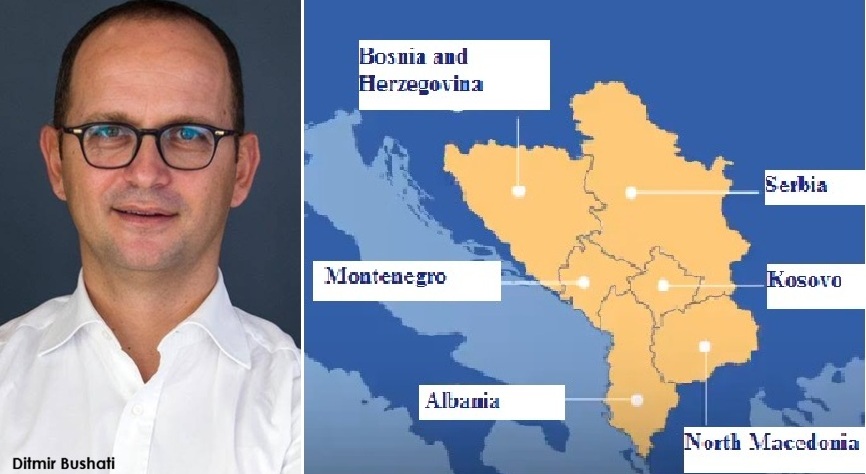
“The EU should support the Student List to prevent the influence of actors like Russia; yet, at the same time, it must not compromise European values and standards, as it mistakenly did in the cases of Boris Tadić and Aleksandar Vučić.”
By Ditmir Bushati,
Tirana, 24 November 2026, dtt-net.com – Last week, I was invited as a speaker to the Security Conference in Belgrade. From my meetings with civil society activists there, one can sense an atmosphere of liberation, though not yet the full taste of freedom. Through disciplined organization, both on the ground and in the digital sphere, and by bypassing traditional, state-controlled media, students achieved an extraordinary victory. They proved that it is possible to break through the closed circle of Aleksandar Vučić’s unchecked power, a man who had long considered himself invincible.
To paraphrase Václav Havel, the elections in Serbia demonstrated the immense magnitude of the “power of the powerless”, the profound strength of civic resistance when social groups with vastly different viewpoints unite.
The student movement in Serbia bears a striking resemblance to the Solidarity (Solidarność) movement in Poland during the late 1980s. Both movements, despite the diversity of their underlying values, succeeded in toppling the incumbent regimes by garnering support from a broad spectrum of social groups.
Much like the French Revolution, which fundamentally altered how political power is conceived, these students must now transform their grassroots civic movement into a parliamentary and governing force.
The Student List represents an unprecedented experiment, a leaderless movement that combines internal democracy with secrecy and discipline in its dealings with external actors. While internal democracy ensures the inclusion and support of its members, it also slows down decision-making. The constituent factions of the Student Assembly hold veto power over candidates proposed for the government. These assemblies function much like a conclave, with members viewing themselves as “shareholders” in Serbia’s future.
The immediate challenge lies in securing a mechanism that facilitates governance and reform, while ensuring the Student List remains engaged in the reconstruction of the public sphere.
The path toward dignity and integrity will not be easy. The dismantling of the existing power structure has only just begun. Aleksandar Vučić has warned that if he were to be arrested, a million people would take to the streets. It should be remembered that Vučić remained in power for 14 years-two years longer than Slobodan Milošević.
The transactional approach adopted by certain EU member states toward his rule will complicate the new government’s relationship with the European Union. However, EU involvement will be crucial in establishing the rule of law, combating corruption and organized crime, and freeing the media from political and oligarchic influence. Bringing security services and military intelligence under control will be the most difficult challenge.
The students want to “put their own house in order” before addressing foreign policy and regional issues. In their view, domestic reforms will, over time, also lead to improvements in foreign and regional policy.
The EU must not miss this opportunity, which is tied to the very transformative nature of the European integration process. The EU should support the Student List to prevent the influence of actors like Russia; yet, at the same time, it must not compromise European values and standards, as it mistakenly did in the cases of Boris Tadić and Aleksandar Vučić.
The new leadership in Serbia should be judged by its results, not its words. The rule of law, geopolitical alignment, and the normalization of relations with Kosovo should be viewed as complementary processes, rather than as separate from one another. At the height of the protests, the students travelled to Brussels and Strasbourg, not to Moscow-signifying their European orientation. Now they must demonstrate this affiliation through the exercise of power.
The Europeanization of the region is a transformative process, but also a generational matter.
In the spring, the Hungarians ousted Viktor Orbán, the politician who had dominated political life since the collapse of communism and turned democracy into a mere façade. In the autumn, the Serbs ousted Aleksandar Vučić and Ivica Dačić, who symbolize the generation of politicians from the wars in the former Yugoslavia.
Despite the unique circumstances of each country, these examples offer grounds for optimism regarding civic resistance in Albania, conveying the message that the “power of the powerless” is greater than the power of any regime.
About the author: Ditmir Bushati is former Minister of Foreign Affairs of Albania (2013- 2019). He previously chaired the Parliamentary Committee for European Integration.
This opinion was published originally at his Facebook account.
The views and opinions expressed in this article are those of the author and do not necessarily reflect the official policy or position of dtt-net.com.