

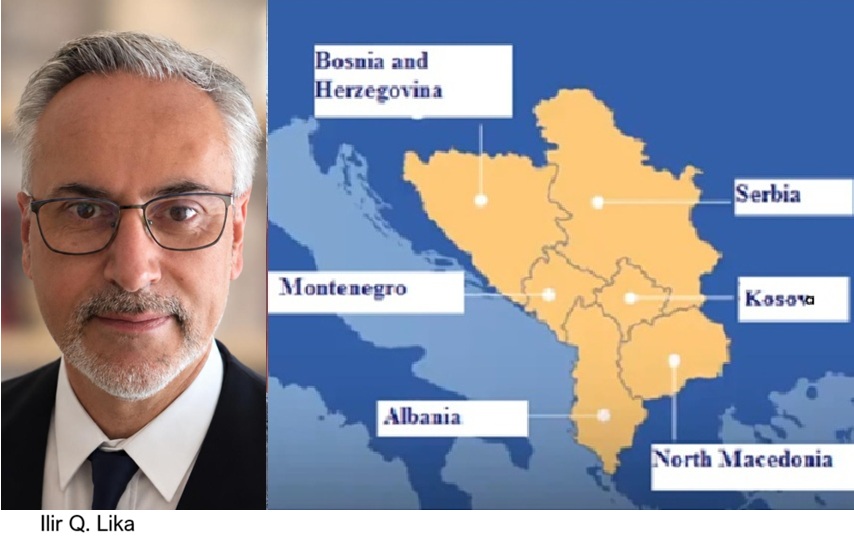
By Ilir Q. Lika,
Brussels, 21 August 2026, dtt-net.com – Toppling one leader and with him (or her) a political force under his total control is not sufficient to bring down a system.
Attempts to topple Albanian Prime Minister Rama is a first wishful goal by his opponents and of many of those who do disagree with existing policial parties and politicians of both camps: in power and in opposition.
But what should be done in a post-Rama period if he is toppled?
It will probably take as much time to unravel the system he has constructed for 13 years.
I deliberately use the word “unravel”. This is not about demolishing everything and starting again from zero. Albania must keep functioning. Businesses must keep working, people must receive their salaries, the administration must function, and the economy cannot stop while politics settles its scores.
Edi Rama may be the first domino to fall, but would follow will probably be the moment when the most complicated part for the future of the country begins.
Because a whole system has been built around power. There is politics, of course, but also part of the administration, the Patronage system, economic interests, and all those who, in one way or another, have had to learn to live with this manner of operating.
Transitional prudence
One should avoid considering everyone who has worked or prospered under this system to be equally complicit.
There are many cases of Albanian businessmen who have managed to work under several different governments. Not because they were Socialists yesterday, Democrats the day before, or would be something else tomorrow. Simply because they wanted to keep their businesses running.
In Albania, unfortunately, things do not always work as they do in a normal European democracy. When political power controls a significant part of the administration and the economy, an entrepreneur quickly understands that it is better to remain on good terms with those who make the decisions.
For some, the choice becomes almost this simple: you play by the system’s rules, or you risk dying economically. That does not mean everything should be forgiven, however.
But it does mean that we will have to distinguish between those who built the system, those who deliberately abused it, and those who simply tried to survive within it.
And even with those who have been negative parts of this system, one will have to think about how to organize the transition. Because if the objective is really to change the system, the future leadership must also give those who are part of it a way out.
This is probably the most delicate point in my reflection.
If tomorrow everyone who has participated in the system is told “Rama falls, and now we are coming after you,” what will they do?
They will defend the system until the last minute. And those who have the means may start moving their money and assets out of the country.
That would be a disaster.
I therefore believe that there will have to be a clear transition period, limited in time.
The message could be simple: rules are changing to return to a normal legal framework. For a defined period, everyone will have the opportunity to regularize their situation and come within that framework.
After that period, the rules should be the same for everyone.
This does not mean granting immunity to those who may have committed serious offences. And it certainly does not mean erasing the past.
It means giving the country a way to leave the system behind without having to break everything.
History also shows us that political changes which suddenly create fear among economic actors can produce exactly the opposite of what was intended: capital departure, a halt in investment and the departure of wealth.
Albania cannot afford that.
The message must therefore be firm about the new rules but reassuring for those who agree to respect them.
Strict about the rules, but not radical against people
This is also why I do not believe that simply replacing one majority with another will be enough.
Of course, in the end, voters take decisions through elections. That is democracy.
But as a first step, I believe a transition phase will be necessary.
Why not a technical government, with a very precise mission and, above all, a very precise time limit?
A government capable of bringing together the country’s different forces, whose task would not be to prepare for another twenty years in power, but to put the rules back in order, calm and stabilize the country and prepare elections in a normal climate.
And I include the Socialists too in this reflection.
I am convinced that within the Socialist Party there are also people who have had enough of this way of operating and who simply want to live in a normally functioning democratic country.
They too should be part of crucial discussions for the future of the country and citizens.
Because the aim must not be to move Albania from the hands of one party into the hands of another. The aim must be to rebuild healthy foundations.
Workforce trend
And while politics fights, there is another reality: Albania’s workforce continues to leave the country because they are looking elsewhere for better wages, better prospects and simply the possibility of building a better future.
At the same time, we see companies recruiting workers from the Philippines, Vietnam, India and other countries where wage levels are even lower. They are doing exactly what Albanians and others in Western Balkans countries have done for decades: looking elsewhere for a better life.
The problem is not the worker. The problem is the system that organizes this competition.
In my view, when a state allows its own workforce to leave and responds by facilitating the arrival of cheaper labor, it is itself organizing a form of social dumping.
It is almost a manual entitled: “How to sabotage your own system.”
The Albanian who asks for a wage that allows him or her to live properly in his own country becomes too expensive. He/she leaves. And instead of asking why is leaving and how to keep him/her in the country, those who control the current system and companies who fight for survival as consequence look elsewhere for someone who will accept working for less.
In the long term, who wins?
Certainly not the Albanian worker. Nor the foreign worker, if his main economic advantage is that he accepts a lower wage. And certainly not Albania, which continues to lose part of its active population.
How do you sabotage your own system? Perhaps simply like this.
Political and institutional transition
In the current context, with the Flamingo Revolution now continuing for more than 80 days in the streets of Tirana, I believe another crucial trap must be avoided: simply replacing one dominant political bloc with another.
A transition could instead be an opportunity to involve as broadly as possible Albania’s political spectrum, civil society, social partners and economic forces.
And once again, that must include people coming from the current system.
Everyone who sincerely accepts the new framework and the new rules must be able to become a serious partner in this reconstruction.
Because this is not about the comfort of one party rather than another. Nor is it about replacing the power of one person with that of another.
It is about rebuilding civil society and the state on healthy foundations.
A state where the administration serves the citizen rather than a party.
A state where an entrepreneur does not need to know the right person in order to work.
A state where a worker can hope to live decently on his or her wage.
A state where whoever wins an election governs, but where institutions are strong enough to prevent that person from gradually turning the state into an instrument of personal power.
For all these reasons, I believe that the possible fall of Edi Rama will only be the first step.
In the meantime, I do not think we should be looking today for one person to “replace Rama”. That would risk falling back into the same personalization of power that the transition should precisely move away from.
My idea is rather to have a technical transition government, with a very clear mission and clearly limited duration. It should represent as broadly as possible the political forces that are ready for democratic change: opposition parties, new political forces, civil society, and also people from within the Socialist Party who are willing to take part in a genuine normalization of the country.
And there is another important element: ignoring the Flamingo Revolution and what has been happening in the streets of Tirana would be another major mistake. This movement must also have a voice in the transition.
Collective response
Today, there are several “fires” burning at the same time: political tension, public anger, distrust in institutions, economic pressure and the departure of part of Albania’s workforce. But there is still time and there are still means to contain these “fires” before they come together and become much more difficult to control.
That is exactly why I believe the first answer should be collective rather than personal.
The role of such a technical government would not be to become the next permanent government, but to stabilize the country, contain these different fires, restore normal rules and institutions, protect the economy and prepare credible elections.
I am not convinced that Albania needs yet another political party. There are already enough parties and new political forces.
What could be much more interesting would be a coalition or gathering of existing political forces around a limited number of common objectives for the transition.
One could imagine something inspired in spirit — not necessarily in structure — by the European People’s Party, where different parties keep their own identity while working together around a common political platform. In the Albanian case, however, I would not necessarily limit such a gathering to the right. It should bring together the forces genuinely committed to democratic normalization.
And importantly, I do not see this as necessarily becoming a permanent electoral coalition. It could be a coalition for the transition. Once its mission is accomplished and normal democratic conditions have been restored, each political force can return to the voters with its own identity and programme.
The objective is not to replace one dominant political machine with another one. It is to create the conditions in which normal political competition can start again. Then the decision must go back to the voters.
The most difficult part will begin afterwards.
Post-election period struggles
The country should be calmed and stabilized without stopping the economy. Restore the rules without causing capital flight. Bring the administration back to its proper role. Give businesses room to breathe. Restore confidence. And above all, give Albanians a reason to believe again that they can build their future in their own country.
The transition would therefore not be political and institutional only. It must also have to be economic and social.
And then after elections, the would-be next leadership will have to build a vision and action plan to for better wages, more investments, more jobs, better jobs, better purchasing power for citizens, businesses, immigration, the diaspora and, above all, fight the reasons why so many Albanians continue to believe that their future lies abroad.
For conclusion: Bringing down the first domino is one thing. Making sure the rest of the country does not fall with it is another.
And that is where the real work must begin to rejuvenate Albania.
———————————————————————————–
Ilir Q. Lika is observer and analyst of Western Balkans politics and EU enlargement.
The views and opinions expressed in this article are those of the author and do not necessarily reflect the official policy or position of dtt-net.com.


