

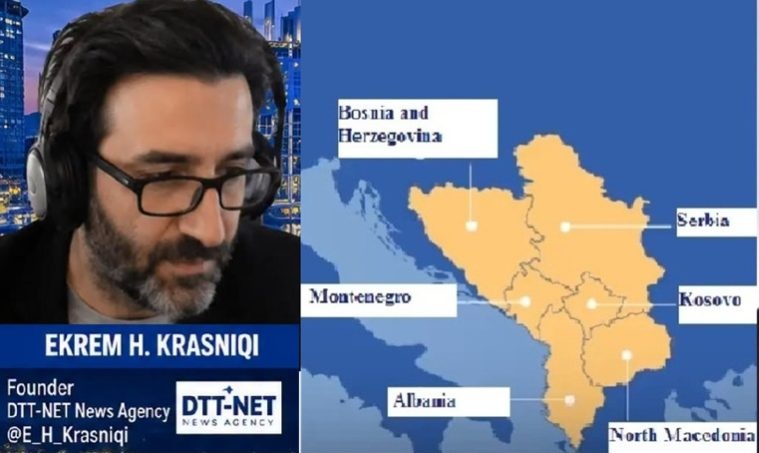
By Ekrem H. Krasniqi, @E_H_Krasniqi,
Brussels, 20 October 2026, dtt-net.com – More than five years ago, I tried to send this exact message via euobserver.com to EU and USA Democrat decision-makers, but it was unsuccessful.
Back then, we in the media and Kosovo Albanians and their politicians, were told that Serb minority in Kosovo needs additional rights, because, we were told, Constitution designed and written by the very same EU decisionmakers and their governments together with USA democrats of Bill Clinton, and initially fed by Marti Ahtisari’s “Comprehensive Proposal for the Kosovo Status Settlement” – was not sufficient and that Russia could use Serbia’s and Kosovan Serbs dissatisfaction.
It was weird then, and remains unacceptable and strange now, that they did not trust their own document after it was turned into a constitution for their own baby-state, which they recognized immediately in 2008 as independent country.
But things have changed since then and the truth can no longer be hidden.
But things have changed since then, and they can’t be hidden anymore. It’s six years now that we, the outsiders, know everything we need to know that EU, UK and USA politicians know before through Rio Tinto of London, about Loznica in west of Serbia and its lithium reserves.
These changes seemed promising for the automotive industries of the United Kingdom, France, Germany, and Italy, but plans are currently on hold, with the four capitals still preparing to gear up how to make it happen, after October 25 Serbia early elections and (hopefully) institutional stability in Kosovo after more than two years of crisis in the newest country in the fragile Europe.
Honestly, they should stay on hold and never be implemented. If they are, these very same countries and the EU as a whole risk inadvertently handing the biggest possible gift to indicted war criminal Vladimir Putin, giving him the power to hit the EU hard in the Western Balkans without ever needing to give the order to his Serb allies across the region.
Fortunately, there are ways to avoid this now. There are solutions to save the automotive industries of these four European nations, gradually escape dependence on China’s lithium monopoly, and push back against BYD’s invasion of European markets.
Two solutions are waiting to be utilized: sourcing lithium within EU territory and its partner countries, and shifting to hydrogen. The second option can and must be adopted by the automotive industry immediately. It needs to be moved from the bottom of the priority list, where it currently sits under REpowerEU. I would call for a “horizontal” listing of funding priorities and green energy goals, rather than the “vertical” hierarchy we see today.
The British company JCB ( @JCBmachines) and its owner, JCB Chairman Lord Anthony Bamford, know exactly what I am talking about. They have already developed functional hydrogen engines, which are currently running in vehicles like the Mercedes Van too.
It is extraordinary what innovative European engineering can achieve for the greater good. However, the mindsets of certain others, and the politicians backing them, risk blowing it all up. They risk destroying 30 years of fragile stability in the Western Balkans, starting with Kosovo and surrounding areas inhabited by ethnic Albanians. This would make Putin happy, leave the EU looking ridiculous, and plunge the region back into deep trouble, while brave Ukrainians, helped by European countries and their taxpayers, continue their war for liberation from Putin’s Russia for more than four years now, and being the frontline defenders of free European Union we all want.
I am trying to send this message once again, but this time with a viable escape route and a happier ending for everyone involved, both down in the troubled Western Balkans, and up here in the struggling EU and UK with their automotive industries, as they face the Chinese “Speedy Bulldozer” of global Critical Raw Materials (CRM).
This is my opinion on how to save the Western Balkans from unwanted destabilization and new bloodshed, while supporting and simultaneously saving the EU and UK automotive industries:
The Lithium Matrix: Why the EU-Serbia Deal is a “Dead-Paper” Asset for the Time Being, Its Chances of Remaining Such Forever, and How the EU Must Pivot to Direct Extraction and Accelerate the REPowerEU Hydrogen Framework
1. The Strategic Stagnation of the Jadar ‘Illusion’
The industrial automotive group of European countries-the UK, Germany, France, and Italy, alongside the Slovak battery makers (InoBat) and the EU executive arm, the European Commission (EC) has not abandoned its aggressive pursuit of the Jadar lithium project in Loznica municipally in west of Serbia. They are simply in a tense, strategic holding pattern. They have temporarily freezed their massive industrial machinery to await the critical October 25 early parliamentary elections in Serbia, knowing that their entire €12 billion automotive gamble rests on whether the local population topples the current regime. After more than two years of signing of the Memorandum of Understanding (MoU) this massive project remains at the moment inside a box as “dead-paper” asset.
The mainstream media in Brussels consistently misreports this stagnation as a temporary local environmental protest. In reality, it is a systemic bottleneck driven by two unalterable forces:
- The Local and Civil Gridlock: The Jadar project relies on conventional underground hard-rock mining. This method requires subterranean blasting, the daily processing of over 1,100 tons of concentrated sulfuric acid, and the permanent creation of massive toxic tailings dams. Targeting the municipality of Loznica, 61.9% of the entire population of Serbia stands firmly opposed fearing an ecological disaster, creating an unresolvable standoff with local inhabitants, environmental organizations, opposition parties protesting students.
- The Sovereign Trust Deficit: Data shows that a majority of Serbian citizens overwhelmingly trust external adversarial powers like Russia and China over the EU. Belgrade’s constant balancing act – maintaining its natural gas, political and military ties with Russia while simultaneously courting US energy and LNG deals – proves that Serbia is a volatile, high-risk foundation to satisfy 26% of EU automotive industry needs.
- 2. Why Jadar is Highly Likely to Remain a “Dead-Paper” Asset Forever
While the four biggest Western European powers, Slovakia, and the European Commission are currently holding their breath awaiting the results of the upcoming October 25 early elections, macro-strategic indicators prove that the Jadar project has an exceptionally high probability of remaining a dead-paper asset permanently, regardless of the electoral outcome:
- Scenario A: Students and the Opposition: 3 opinion surveys of this year indicate that students are poised to topple the ruling SNS party of Russia/China-friendly Aleksandar Vucic. If students remain loyal to their baseline platform, they will legally and permanently cancel the Loznica concessions to prevent the feared environmental catastrophe. Even if the industrial group of the three countries within the EU and the UK attempts to entice a new government with expedited EU accession negotiating chapters or concessions over Kosovo, the domestic political cost of breaking the anti-lithium pledge would trigger immediate internal political instability and risk collapse of government.
- Scenario B: The Current Regime Survives: Even if the regime of Vucic retains power through political manoeuvring, it cannot manufacture social compliance. Attempting to force heavy-impact underground mining, sulfuric acid processing, and tailing storage onto an unyielding population will result in continuous civil sabotage, labour strikes, and systemic logistical blockades. For multi-billion-euro automotive groups such as Stellantis, together with Mercedes and VW/BMW a supply chain subject to persistent domestic blockades represents a significant barrier to investment and long-term capital commitment.
- Scenario C, regional instability risk with pandora box potential with demands in surrounding countries, Serbia itself. Appetite for autonomies across the region would erupt, because of autonomy named ‘Association of Serb-majority Municipalities – ASM’ push on Kosovo Albanians, which in other terms would be a second version of Dayton 2, this time for Kosovo, and would easily make Kosovo dysfunctional and blocked by Serbs at their will and perfectly be used by Russia at its will each time it needs to blackmail and threaten the EU using inter-ethnic divides within Kosovo, as its using them in Bosnia and Herzegovina (BiH).
A such scenario with ASM formed, ethnic Albanians in North Macedonia will, one or the other way soon get ‘hungry’ too, to get something more that they have with the current Constitution which was updated following 2001-armed conflict. and similar that the EU+UK are pushing for Kosovo Serbs.
Until 2011, the former leader of guerilla of Macedonia Albanians, Ali Ahmeti, has been warning that if Serbs would be granted their autonomous body for ten Serb-majority municipalities, it would impact Macedonia and would trigger same demands there by country’s Albanians.
How tensions in Kosovo can easy spread out of its borders is the latest example of daily protests in Prishtina for 18 consecutive days, triggered by the guilty verdict by European and American judges at the special war crimes court in The Hague on former Kosovo President Hashim Thaçi and three other former leaders of the now disbanded Kosovo Liberation Army (KLA). Rallies took place in Skopje too.
Albanians in Presevo Vally, Bosniaks in Sandzak, both regions in Serbia and Montenegro, should not be ignored. They will see eventual formation of ASM in Kosovo as a food for thought and chance for making their own cases to take the streets and demand the same.
All these potential situations indicate that the EU, Germany, France, Italy, and the UK are gambling and risking big and destroy with their own hands the stability and fragile peace which they build together with the USA in the region, since the end of Kosovo war, and since the end of Bosnia and Herzegovina war too.
If they continue pushing and pressing Kosovo politicians and their supporters to satisfy Serbia demands within Kosovo, in trade off with Lithium in Loznica, they are risking handing over accidentally the biggest gift they have never wanted to give to Vladimir Putin.
That’s why Democrats in the USA, once they are likely to return to the White House in 2 years, should completely abandon support to EU and Serbia push for ASM in Kosovo. If anything happens in the region, it will be USA and its taxpayers and its soldiers together with soldiers of other NATO/European countries who would be needed to solve EU’s own mess in its backyard, again.
Furthermore, the ouvert geopolitical blackmail deployed by Belgrade has permanently damaged its credibility. The timeline of this leverage is clear and documented:
- 20 August 2024: As reported by dtt-net.com, Serbia’s Deputy Prime Minister, Aleksandar Vulin, explicitly broadcast the threat to the Russian Sputnik agency. Vulin stated flatly that Belgrade authorities had never promised that Rio Tinto would be hired for the lithium mining project in Loznica, because there are “other countries in the world which are very much interested” with “other technologies which can be useful to Serbia” too.
- 18 November 2024: The resulting panic inside Brussels was accidentally exposed during a European Parliament Foreign Affairs Committee (AFET) debate. Defending the European Commission from fierce MEP criticism over its blatant appeasement of Belgrade’s democratic backsliding, the former European Commissioner for Enlargement, Olivér Várhelyi, explicitly blurted out to the committee: “…don’t forget about lithium which is concluded [by Serbia] with Europe, it’s not with China.”
The “Modern beautiful Hospital” Metaphor
Terrified of Vulin’s threat of a total technical and structural pivot to Beijing, the four-government industrial group, the European Commission, and the EEAS (European External Action Service) are blindly willing to sacrifice regional stability and actively trade away the constitutional functionality of Kosovo to satisfy Vučić’s lithium terms. And the very same will certainly try and do with students if they come in power.
They are aggressively pressuring Prishtina to establish an autonomous Association of Serb-majority Municipalities (ASM) according to the status proposed by the EU in October 2023 beyond the established Kosovo laws on NGOs. By doing so, Western powers are committing a profound geopolitical error. The Kosovo Constitution, drafted by Western powers themselves, remains the most modern, protective framework for minority rights on the entire continent, EU countries including, even better than the Ohrid Agreement for Macedonia which was also mediated by western powers ending 2001 conflict.
Forcing an unconstitutional, executive ethnically driven body onto Kosovo is akin to imposing an internal cancer on a healthy population and its country.
The four capitals, the EU Commission, and the EEAS are patronizingly promising vulnerable Kosovo Albanians a “good life” in a “modern hospital” where nurses and doctors will treat them, feed them well three times a day, and check on them, while failing to mention that they are the ones injecting the cancer into the state’s organs just to secure a stalled corporate transaction. Brussels and its industrial backers are actively risking the creation of a second permanently dysfunctional state just south of Serbia.
Bypassing or “killing” of Constitutional Court of Kosovo by those who wrote the ASM status of 11 October 2023, is named with the painted and hidden name: Arbitration Commission (article 42 of the ASM EU (Germany-France proposed status), when it comes to the disputes between the aimed Serb-body finances by Serbia, and Kosovo’s central institutions in Prishtina.
In other words, autonomous institutions made of and representing ten Serb-predominantly municipalities (4 north of Iber River and 6 south of Iber River) would each time they have a dispute with Kosovo institutions, or Kosovo institutions would have a dispute with Serb ASM institutions, would be treated by the Arbitration Commission, and in a situation their representatives would fail to reach a compromise, then it’s an EU appointee who will be the judge (arbiter).
This is nothing less than a brutal murder in silence of Kosovo’s sovereignty and its constitutional order without mercy, but with a smile of a “doctor”.
While any decision of Kosovo politicians on the ASM / Autonomy should be decided by Kosovo citizens in a referendum, the ultimate health-measuring a democracy in countries who pretend to respect the real meaning of ”democracy” (demos-kratos in ancient Greek). The same right should be given to Serbia citizens on lithium in Loznica.
Serbia people should be given the right to decide on lithium project in a referendum too. If they want lithium industry in their arable land with environmental, biodiversity and health (long term risk) or continue with fruit, vegetable and agriculture sector development in the wider area in east of the country, it’s their and solely their choice, because it’s about their life and they should be the masters of their own lives, no one else.
The alternative for Serbia’s Lithium
3. The Structural Shift: Pivoting to Secure, Legally Stable, and Environmentally Favourable EU Regions
To break China’s processing monopoly without compromising regional stability, the European automotive group of four countries must abandon hard-rock appeasement in Serbia and pivot its capital to environmentally favourable Direct Lithium Extraction (DLE) within the secure, legal borders of the EU core (such as Germany’s Upper Rhine Valley and the Altmark region).
The hydrogeological ceiling of liquid brines such as Vulcan Energy’s 21,114 tonnes per annum of LCE targets in Landau, and in Neptune Energy 25,000 tonnes per year target in Almark are the alternatives to the risky one in Serbia. The two together equal Loznica amount of lithium quantity as the end product ready to be used for batteries. And by adding strategic projects of Critical Raw Materials the European Commission has put in the list since last year, of which of lithium too, the future lithium supplies of the EU, although far from reversing dependence from China, is worthy.
None needs instability in the Western Balkans so EU citizens can drive their vehicles in speedy highways with lithium-ion made batteries in Serbia.
4. Upgrading REPowerEU: A Strategic Mandate for Trans-Continental Capital
The economic architectures of Europe require a radical overhaul to catch up to accelerating geopolitical realities. Just last month, the European Court of Auditors published a scathing report dismantling Brussels’ and EU-27 governments slow pace on the green energy transition, exposing that EU governments have committed only €54.3 billion, not even the fifth of the evaluated €300 billion in capital required to meet real-world renewable/green energy infrastructure needs.
Hydrogen delayed solution
To survive this clean-energy lag, the upcoming structural upgrade to REPowerEU must shift away from administrative box-checking and aggressively fund deep-earth natural hydrogen research across both the EU-27 core and the aspirant countries, 8 candidate countries and Kosovo too.
- Immediate EU Core Security: Institutional capital must be mobilized to immediately fast-track and exploit the massive, proven natural hydrogen reserves of France, placing them at the absolute top of the domestic supply chain priority list for immediate European industrial consumption.
- The Parallel Aspirant Network: In parallel, wide-area exploratory frameworks must be launched across the official candidate nations. These projects should be engineered for local regional consumption, paired directly with the installation of localized end-use industrial consumers and state-of-the-art cross-border transmission networks to route surplus zero-carbon gas straight into today’s EU territory.
Pre-Announcement: Designing the EU-36-Canada Family Corridor
This dual-track energy expansion cannot be achieved under old regulatory frameworks. It requires a profound geopolitical leap: a new Associate Member Status legally engineered to bond the expanded European continent to global resource superpowers.
This upcoming signed framework will define a deep political, economic, and defence sector alliance, starting with specialized Canadian companies deploying their world-class expertise in natural hydrogen exploration and advanced H₂ electrolysis directly alongside Western Balkans, Ukraine, Moldova and EU enterprises.
This tactical partnership moves deliberately beyond the LNG sector – where the United States is currently moving fast and rightly to terminate all remaining Russian gas supplies from the European continent forever – to aggressively prepare the regional grid for a post-fossil energy landscape.
Hydrogen must be placed at the core of this medium- and long-term strategy and the next REPowerEU should create a horizontal balance of priorities and move Hydrogen from the bottom of the list and energy planed sources to the equal level of priorities with wind, solar and geothermal.
In one of our next Energy Macro-Strategy Briefing briefings, we will present a comprehensive vision for a Pan-European-Canadian Alliance (the EU-36 + Canada Family) and reveal exactly how this framework must be legally, defensively, and industrially designed to secure as much as possible energy independence while working flawlessly for the mutual benefit of all democratic partners.
This vision has more chances in becoming a solid rock of the western world, once Donald Trump ends his mandate and a new leadership arrives in the White House to first halt and repair the damages done to the 80-year alliance built by the two sides across the Atlantic and then revive and boost the engine together with the EU-Canada family.
———————————————————————————-
(About the author:
Ekrem H. Krasniqi is a veteran journalist, political analyst, and the founder of dtt-net.com, an independent English-language press agency focused closely on the Western Balkans, the European Union, and European energy security. In his opinion articles he advocates for forward-looking investments-such as joint hydrogen (electrolysis ad natural hydrogen) energy initiatives in the Western Balkans, especially in Albania, Kosovo and North Macedonia, jointly with the EU and other western ally countries of NATO in the context of RePowerEU strategy and goals – to bolster the region’s economic and political leverage.
