

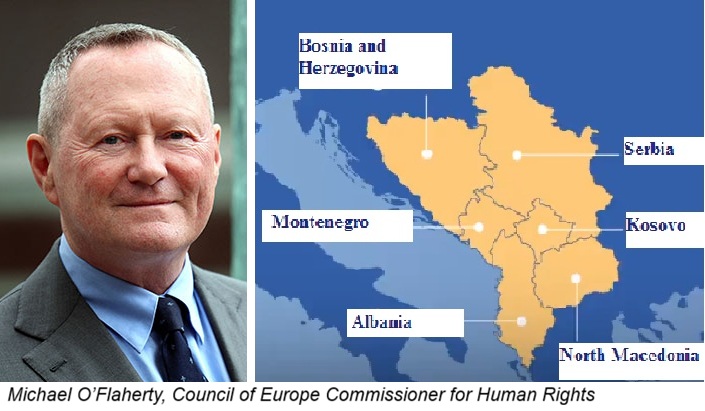
By Michael O’Flaherty,
Geneva, 17 September 2026, dtt-net.com – I have been following the situation in Serbia very closely for the past two years, focussing in particular on a set of human rights: freedom of expression, including media freedom, peaceful assembly and the policing of protests, as well as the state of civil society. I have conducted two visits, the first in April 25 and the second in May of this year.
Between these two visits, I’ve observed a sharp decline in respect for human rights, a decline, which I consider has continued over the summer months. The circumstances are very well known to all of you.
There is the harassment of journalists, next to no accountability for police attacks on them, the deployment of slaps against critical media, a deeply distorted media market which favours pro-government outlets.
There are the attacks on peaceful protesters by police and by their unidentified collaborators in a context of effective impunity of the attackers.
Relatedly, we have the recent dismissal by the Higher Public Prosecutor’s Office of claims regarding the firing of a sonic weapon in March 2025, despite 3,000 testimonies provided to the authorities. And I’m also disturbed that the Higher Public Prosecutor has recently issued threats to prosecute the so-called spreading of false information regarding the sonic weapon.
There is the dangerous smearing of legitimate civil society actors as traitors or foreign agents, thus putting them at risk of violence.
Very recently there are reports of the discovery of spyware on the phones of civil society actors.
And of course, most recently of all, there was the disgraceful glorification in death of Mladić. This was all the more disturbing for me personally, as I was based in Bosnia Herzegovina for some of the war years, where I chronicled his crimes, I witnessed the atrocities of his troops, and I even negotiated to try and achieve a decent burial for victims.
Behind the human rights situation, as I observe it, we can see an erosion of elements that are essential for the protection of human rights and the upholding of rule of law.
Within the scope of my own work, I have observed, for instance, the widespread collapse of trust in the police; the very problematic record of the Office of the Higher Public Prosecutor.
(And, by the way, we should continue to call for implementation of the Venice Commission recommendations regarding the Mrdić laws on prosecutorial autonomy). Then there are the deficiencies in the operation of the Protector of Citizens, the Ombudsman. There is the seeming collapse of previous cooperation mechanisms for human rights actors and the state.
And, as I have already mentioned, there are the impediments to the essential work of civil society and independent media.
Beyond any further elaboration of the problems, let me simply cite a Serbian human rights expert whom I know and respect deeply, who has lived through the turmoil of the 1990, and who told me that the situation is worse today.
Going forward then, can I be hopeful? My answer to you today here is a clear yes, and here’s why.
First, there are so many people like my friend, brave, principled, and tenacious. They are human rights champions, and they can be found right across Serbian society.
There are the resilient civil society organisations that struggle on regardless of the pressure.
There are the impressive academic leaders who will not be silenced, who follow on in the legacy of such giants as Professor Vojin Dimitrijević, who some of you will remember, and who so often walked these very corridors.
There is the growing regional and international attention to the situation, and the notable convergence of analysis and critique within the UN, the Council of Europe, the OSCE, and even the EU.
Most important, there are the young people of Serbia who insist on living in, and are determined to achieve, a state of which they can be proud.
——————————————————————————————–
The text is transcript of remarks by Michael O’Flaherty, Council of Europe Commissioner for Human Rights, at the side event “Fundamental Freedoms Under Pressure: Human Rights and Accountability in Serbia”, organised by the Belgrade Centre for Human Rights at the 63rd session of the UN Human Rights Council in Geneva.