

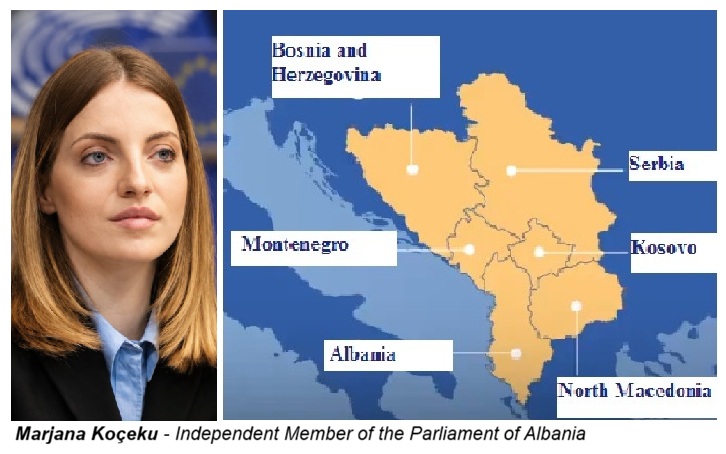
By Marjana Koçeku , @MarianaKoceku1
Tirana, 23 September 2026, dtt-net.com / democratsreview.eu – It began with a threatened landscape. It became a revolt over Albania’s future. As the Flamingo Revolution nears its hundredth day, a spontaneous environmental protest has grown into a wider challenge to political power, unchecked development and democratic accountability — driven by a generation demanding the right to defend its land, its dignity and the country it will inherit.
We are in Albania, where an unlikely revolution is approaching its hundredth day: the Flamingo Revolution.
It was neither planned nor orchestrated. It emerged spontaneously from civic anger at what many Albanians see as environmental and democratic violence against our land. Its deeply civic and spontaneous nature is precisely what makes it so powerful and beautiful.
To understand how a conflict over a protected landscape became a broader political movement, one must understand Albania itself.
Our country went through a transition that followed promised freedom, democracy and prosperity, but produced its own contradictions. Institutions remained fragile, political power became concentrated, emigration hollowed out communities, and the boundary between economic and political power became increasingly difficult to discern.
Yet another Albania gradually revealed itself to the world: mountains, rivers, wetlands, villages and an extraordinary coastline that had escaped some of the intensive development experienced elsewhere in Europe.
Tourism transformed many Albanian families. Mine was one of them.
In rural northern Albania, where I come from, tourism offered something particularly important: a reason to stay. It created opportunities in communities long affected by migration and encouraged some young people to return.
But Albania’s natural beauty also attracted another kind of interest. As tourism expanded and land values increased, some of the country’s most valuable landscapes became targets for ambitious development projects. Places that should represent a national ecological inheritance began to be treated primarily as economic assets.
First came conflicts such as Rrjoll in northern Albania. Then came Zvërnec. Both possess extraordinary natural potential and sensitive ecosystems; both occupy strategically valuable coastlines. And both raise the same fundamental question: Who ultimately owns Albania’s natural wealth the public, or those powerful enough to acquire the right to transform it? During a protest against the development associated with Jared Kushner’s proposed project, a protester was subjected to violence by private security personnel while state police were present. For many Albanians, the images raised a question more disturbing than the confrontation itself: what happens when the state, whose responsibility is to protect its citizens appears instead as a passive observer?
I do not know whether it was the violence, the perceived indifference of the state, years of accumulated frustration, or all of these together that triggered what followed. But something broke. The protest moved beyond Zvërnec. Demonstrations reached Tirana and other parts of Albania, while the Albanian diaspora organised solidarity actions abroad. Young people, activists, environmentalists, intellectuals and professionals carried its message internationally.
A dispute over a landscape had become a national conversation about justice and democracy.
That happening placed the government in an uncomfortable position. It placed me in one too.
I was newly elected to Parliament with the governing Socialist Party. Many of those demonstrating belonged to my generation. I could not sit inside the institutions of power and pretend that I could not see them.
They were protesting for the nature, for their dignity, their homeland and future.
Zvërnec was not the first issue on which I had disagreed with the Socialist Party. But the protest became a point of moral and political clarity.
Leaving the Socialist parliamentary group was not, in my view, an act against politics. It was an act in defence of what politics should be: public service, accountability and representation of citizens rather than obedience to power.
I therefore chose to continue my mandate as an independent Member of Parliament to support the protest and to exercise my mandate freely, speaking out and standing firmly for what I believe is right and serves the public good.
My decision was inseparable from my own history.
Before entering Parliament, I spent years involved in civic activism in Shkodër and Tirana. Environmental protection was among the issues closest to me. I participated in clean-up and awareness campaigns and later founded Neomalsore, an initiative rooted in ecological tourism, rural development and the conviction that economic opportunity does not have to come at the expense of nature.
The Flamingo Revolution has faced criticism and attempts to delegitimise it. Yet I believe it is one of the most important civic developments Albania has experienced in decades.
A forest, a river, a lagoon or a beach is not empty space waiting for an investor. It is part of a common inheritance. And our homeland belongs also to those who aren’t born yet, this is why is called inheritance and it must be treated as such.
This protest is shaping a new political culture based on active citizen participation in the public sphere. Today, the demands surrounding the Flamingo Revolution extend far beyond Zvërnec.
They concern corruption and the concentration of political and economic power; depopulation and young Albanians who were forced to believe their future lies elsewhere; social injustice, unequal opportunities, public services, meritocracy and equality before the law.
Ultimately, they lead to a simple but profound question: What kind of country should Albania become?
For too long, development in Albania has been measured predominantly through construction, investment, tourist numbers and economic growth. These indicators matter. But a country cannot measure progress only through what it builds. It must also measure what it preserves and above all: the well-being of local communities and the people who call these places home.
I am not against development but i believe that a positive development must be inclusive, meaning that it should protect diversity, empower local communities, improve their well-being, and maintain a sustainable balance with nature.
We need to rethink the concept of what we call development.
I believe that alongside with the Social Contract, we also need a Natural Contract.
Such a contract would recognise that our obligations exist not only between citizens and the state, but also between nature, communities and the territory we inherit.
Rivers, forests, mountains, wetlands and coastlines are part of our identity.
They are part of the ecological foundations of our society, economy and national identity.
We must respect the principle of solidarity with future generations. Environmental protection is therefore not an obstacle to Albania’s development. It is a development strategy and a responsibility towards present and future generations.
Albania’s European future
This debate is particularly important as Albania moves towards membership of the European Union.
European integration cannot be reduced to the technical opening and closing of negotiating chapters, nor can it remain an exercise conducted exclusively between ministries in Tirana and institutions in Brussels.
The European project must be felt in the everyday relationship between citizens and the state. It must mean stronger institutions, genuine rule of law, environmental protection, transparent decision-making, democratic participation and equality before the law.
Environmental governance is inseparable from this European future. Chapter 27 of the EU acquis environment and climate change should not be treated merely as a bureaucratic obligation. It goes to the heart of the development model Albania chooses. The paradox is striking: Albania’s natural landscapes are among its greatest European assets, yet precisely because they have become economically valuable, they are increasingly vulnerable.
Europe should therefore look carefully at what is happening in our protected areas and the laws that are undermining them. Not because the European Union should determine Albania’s domestic politics, but because accession must remain a process of democratic transformation rather than merely geopolitical alignment.
Albanians are overwhelmingly European in aspiration. European integration will retain its credibility only if citizens can see European principles reflected in how power operates at home.
The Flamingo Revolution has already achieved political and social victories.
I consider my own departure from the Socialist parliamentary group one of them, because this movement greatly inspired my decision.
This movement has created a new political culture in out country. For decades, Albanian politics has been dominated by political parties, powerful leaders and permanent confrontation between political camps.
The Flamingo Revolution has introduced a different protagonist: the citizen, and particularly a young generation unwilling to remain spectators.
This is why the government of Prime Minister Edi Rama should not treat the protest simply as an adversary to be defeated or a temporary disturbance to be endured. It should take action on people’s demands.
Every politician ultimately conducts their most important political analysis not in party headquarters, opinion polls or social media, but among the people they represent.
As the Flamingo Revolution approaches its hundredth day, its significance can no longer be measured only by whether one project proceeds or another is stopped. Its deeper meaning lies in the political consciousness it has awakened.
The Albanian people are united and determined to defend what belongs not only to us, but to generations yet to come and what no power should be allowed to take away: our nature, our land, and our dignity.
—————————————————————————————
Marjana Koçeku isIndependent Member of the Parliament of Albania.
This opinion of her was originally published at Democrats Review a joint project of the Institute of European Democrats (IED) and the European Democratic Party (EDP), with the financial support of the European Parliament.

