

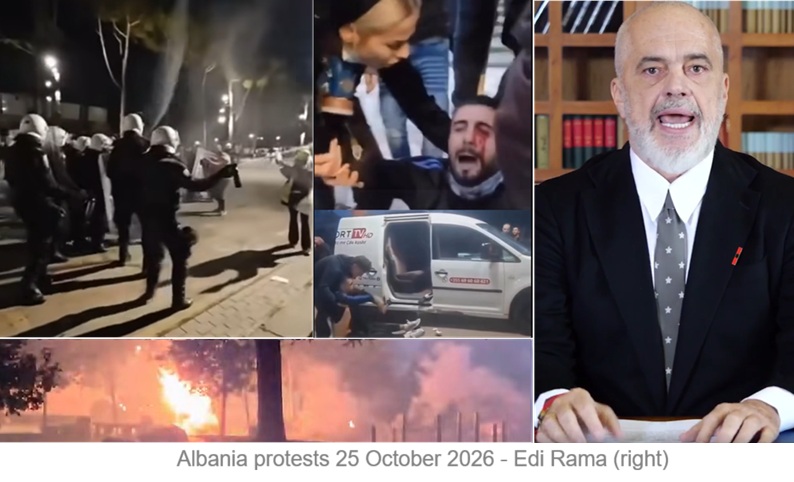
Tirana, 05 November 2026, dtt-net.com – The government of Prime Minister Edi Rama has launched an aggressive campaign of financial penalties targeting protesters who take to the streets daily to demand his resignation, signalling that the deep-seated political crisis in the EU-candidate nation is far from over.
The interior ministry’s latest crackdown involves issuing heavy administrative fines to demonstrators under the pretext of blocking traffic in the capital city of Tirana.
Critics blast the move as a direct attempt to intimidate student-led protesters.
Students joined by parents, teachers and professors, but punished for protesting
The movement has recently swelled, drawing in parents, teachers, university professors, and intellectuals who refuse to back down.
The current wave of unrest has seen 23 days of violent clashes, which erupted after more than 130 days of peaceful demonstrations originally triggered by Rama’s unwavering insistence on pushing through construction plans for luxury tourist resorts in two locations of the Vlora municipality.
The controversial projects involve Qatari investors alongside Donald Trump’s son-in-law, Jared Kushner, and his daughter, Ivanka Trump.
The escalation drew sharp condemnation from the political opposition. Democratic Party (PD) lawmaker Gazment Bardhi made public an official police citation issued to a demonstrator for attending a street protest. The document cited ‘traffic hindering’ and ‘refusing’ to obey a police warning regarding a traffic blockade.
“Penalizing citizens solely for the fact that they exercise their right to participate in a peaceful protest constitutes a grave act of arbitrariness and censorship against fundamental freedoms. The right to assemble and protest peacefully is guaranteed by the Constitution and cannot be interfered with, imitated, or extinguished through fines or violence,” Bardhi stated in a Facebook post.
He warned state authorities that weaponizing financial penalties against constitutional rights carries severe consequences.
“No one is above the Constitution, and no one can use state authority to punish the exercise of a fundamental right. Anyone who signs such acts commits a criminal offense. Obstructing the exercise of the right to assembly and manifestation cannot be left without responsibility,” Bardhi added.
The stakes remain extraordinarily high for both the government and the public. More than 400 protesters have been detained, and dozens of demonstrators and law enforcement officers have sustained injuries during the 23 consecutive days of clashes. With neither side willing to step back from their positions, the financial crackdown marks a dangerous new chapter in Albania’s ongoing civil unrest.
The root of the crisis: The “Flamingo Revolution”
The current civil unrest grew out of the “Flamingo Revolution,” a wave of environmental and anti-corruption demonstrations that began earlier this year.
Protesters adopted the pink flamingo as their symbol after plans emerged to build mega-resorts in ecologically sensitive coastal zones, most notably the protected Vjosa-Narta wetland lagoon and Sazan Island. Environmentalists and local groups warn that the massive footprint of these projects-which foresee up to 10,000 luxury villas-directly threatens local wildlife habitats, including nesting grounds for protected flamingos and sea turtles.
The Trump-Kushner and Qatari Connection
At the heart of the public’s outrage is the involvement of high-profile foreign investors. Edi Rama’s government fast-tracked the multi-billion-dollar tourism developments in partnership with Affinity Partners, a private equity firm founded by Jared Kushner. Reports indicate the projects are backed by a network that includes Kushner, Trump’s daughter Ivanka, and two Qatari billionaire brothers.
Public resentment has intensified over a perceived lack of transparency, allegations of land grabbing, and local property disputes. Investigative findings have also linked some of the targeted development land to a series of unresolved local fraud and document-forgery court cases.
Convergence of grievances and EU accession risks
What started as a targeted environmental defence has converged with widespread economic and social frustration. Student groups have tied the “Flamingo” grievances to a broader fight against systemic government corruption, the soaring cost of living, severe youth unemployment, and underfunded education infrastructure.
The fast-tracking of these projects has created diplomatic friction. To allow construction in these coastal areas, the Rama administration passed a contentious strategic investment law that rolls back existing environmental protections.
The European Parliament (EP) has strongly rebuked the move, calling for the legislation’s repeal. EU Commission officials have also warned that compromising established environmental standards directly undermines Albania’s ongoing negotiations for EU accession-a milestone the country is actively trying to achieve.
In July, the EC warned Rama’s government that the country cannot close environmental negotiating chapter in ongoing accession talks, without correcting the law on ‘protected areas’ and annulment of the law on ‘strategic investments’.
The EC told dtt-net.com that Albania should make corrections to the law on ‘protected areas’ and annul the law on ‘strategic investments’, in order it can to close negotiating chapter 27 on ‘environment and climate change’ in the EU accession negotiations as Albanian government has so far opened all 33 negotiating chapters, closed 4, in the short period of 15 months and is hoping to start closing them soon.
But stubborn prime minister of Albania is refusing to reverse contested laws by protesters, the EP and the EC.

