


( Written and edited by Ekrem H. Krasniqi, @E_H_Krasniqi )
Brussels/Prishtina, 25 October 2026, dtt-net.com – Germany has yet again reiterated its and of other EU governments and institutions the long-standing stance that Kosovo’s stalled path toward European Union membership remains contingent on the establishment of a contested autonomous body for its ethnic Serb minority-a move heavily backed by Serbia and Russia too.
Speaking to the Kosovan press agency Ekonomia Online, German Ambassador to Kosovo Rainer Rudolph directly yet again linked progress on Prishtina’s EU application of December 2022 to the implementation of the controversial Germany-France designed “Association of Serb-majority Municipalities – ASM of October 2023, thus continuing a diplomatic leverage strategy that EU institutions and its governments, backed by the USA governments of Democrats, have utilized for over a decade.
“There are specific steps on the Kosovo side that can be taken, for example, the implementation of the agreement to provide self-organization for the Serb minority,” Rudolph said.
“How that is to be done, we will see. But there is a lot of work to be done, definitely for both countries,” we went on talking, without mentioning the fact that five of 27 EU member states (Cyprus, Greece, Romania, Slovakia and Spain) refuse to recognize Kosovo’s independence of 2008.
In return for moving forward on the formation the ASM – a project Kosovo Albanians fear would create a mini-state vulnerable to Belgrade and Moscow’s influence – Rudolph offered the “carrot” of unlocked EU pathway.
“It’s also true there are steps that need to be taken on the European side, like for example forwarding the membership application to the European Commission so that the progress can proceed,” Rudolph said, framing the move as a reciprocal advance in the Belgrade-Prishtina dialogue.
The Ambassador urged yet again for immediate diplomatic movement, and resumption of the talks in Brussels mediated by the EU chief of diplomacy Kaja Kallas, following the formation of Kosovan government last month, after nearly two years of institutional and political instability in Kosovo.
Coordinated pressure and “carrot” from Brussels, Berlin, Paris, Rome and London
This diplomatic push aligns with broader, persistent demands from Brussels, Berin, and Paris, and London too, although the UK is not anymore EU member.
Kallas previously urged Kosovo’s political factions to quickly form a stable government following early legislative elections of June.
The explicit goal behind the EU’s call for institutional stability is the immediate resumption of EU-mediated negotiations with Serbia with the central aim to establish the ASM, while the EU, its automotive industry and of the UK too are desperate to implement the 2024 Memorandum of Understanding (MoU) and start digging massive lithium by the British Rio Tinto in Loznica municipality for a complete value chain of electric vehicles for Stellantis Group, VW, BMW and Mercedes, as Serbia’s confirmed reserves represent up to 26% of EU automotive industry needs annually for 40 next years.
Central to these rebooted talks is the implementation of the 2023 agreement, which mandates the creation of the highly controversial autonomous body for the Serb minority.
While Western mediators view the mechanism as a necessary step toward what they call “normalization” of relations between Kosovo and Serbia, the project faces deep domestic resistance by Kosovo Albanian citizens.
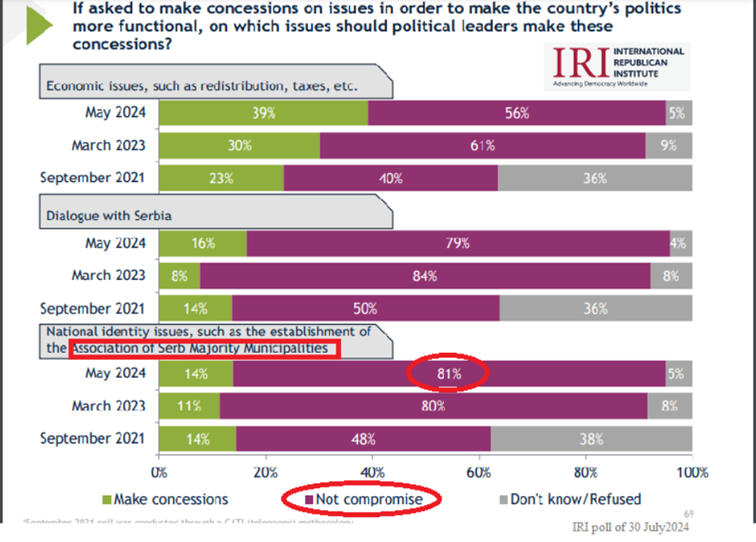
The public opinion poll of 2024, conducted the American International Republican Institute (IRI) revealed that 81% of Kosovo citizens reject the ASM body wanted by Serbia, Russia and the EU and its government, warning that an ethnically and administratively divided system would paralyze the young state in a manner similar to Bosnia and Herzegovina (BiH), although with different symptoms.
The Foundation: The 2023 Normalization Agreement
The diplomatic framework driving this current push is anchored in the EEAS Agreement on the Path to Normalisation, which was verbally accepted by both sides, Kosovo Prime Minister Albin Kurti and former Serbia President Aleksandar Vucic in Brussels in February 2023. This was quickly followed by its corresponding EEAS Ohrid Implementation Annex in March 2023.
Under Article 7 of this pact, Kosovo’s Kurti committed to establishing a specific level of “self-management” for its ethnic Serb population. In return, the agreement dictates that Serbia must not object to Kosovo’s membership in any international organizations.
However, the entire process has remained paralyzed because Belgrade refuses to sign the document in a legally binding format, while Prishtina refuses to move forward on domestic concessions without a formal signature.


