

Albania landscape is attracting western tourists increasingly fast. While local mobilization to improve related services in the tourism sector is the next necessary step, the green energy sector should be at the top of the priority list to revive the economy of the Western Balkans country. The production of green hydrogen with electrolysis technology, together with recently discovered Natural Hydrogen in east of Albania, is the second immense potential for which Albanian authorities should begin to mobilize through co-investments with the western allies for the needs of regional and European markets.
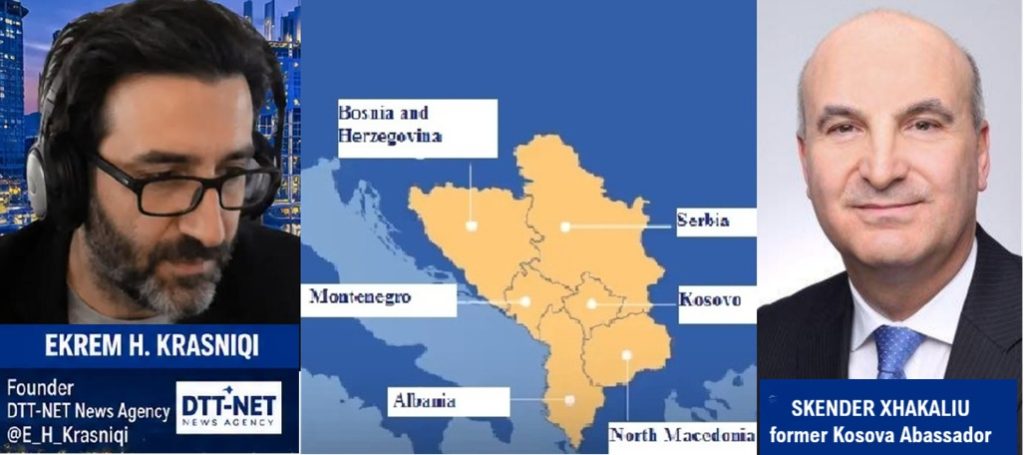
By: Ekrem H. Krasniqi @E_H_Krasniqi and Skender Xhakaliu ,
Albania’s economy, one of the most underdeveloped in the European continent, has an open perspective and is in the hands of its leadership and citizens.
The possibilities to make a new and big step in the near future in both sectors are immense, precisely at the moment of major clashes between the world superpowers of the two blocs, the countries of the West and the Russia-China tandem, respectively.
Hydrogen
The green energy sector is an extraordinary opportunity for Albania, and precisely at the moment when developed countries are in massive mobilization for clean energy sources.
Countries of the European Union, as well as the Unites States of America and allies of the two Western powers, are already mobilizing for the production of Green Hydrogen as well.
In the list from the NATO member countries, and following the upcoming EU-Canada new economic relationship between the two, the yet to be designed EU ‘associate member” status for Canada, Albania should start attracting interest and open door to Canadian companies specialized in Hydrogen business too.
The European Union, in its first REpowerEU document of 2022 has included Green Hydrogen in the list of concrete plans with other sources of renewable energy, and since then the funds for the necessary investments for Green Hydrogen production are piling up.
The European bloc has created a special bank for Hydrogen production, namely its production by splitting water (H20) into hydrogen (H2) and Oxygen (O), i.e. for electrolysis production technology and follow-up installations and facilities for transporting it to industries for its use.
In early 2024, just two years after the first version of REpowerEU, the European Union’s plans for hydrogen production have been upgraded. From the initial amount of 20 million tonnes per year until 2030 (of which 10 million to be produced in African countries and imported from that part of the world), the aim is to produce up to 35 million tons of Green Hydrogen per year for the EU market by 2040.
In the midst of EU energy plans and actions, Albania must seize the moment now and not later. Albania has over 470 km of coastline which should be used for Green H2 production.
In early 2024, French researchers said that in Bulqizë mine, there are also reserves of Natural Hydrogen, the quantity of which still needs to be determined precisely beyond first estimations. Some other unofficial research say that Natural Hydrogen can be found in other locations in Albania too.
The new discovery makes Albania with two Hydrogen potentials: the sea and the land, to become a producer of hydrogen and other products that come out of hydrogen itself, and for which the European continent needs for its green energy strategy and plans to achieve the super goal of energy independence, or at least semi-independence, considering the transitional phase from use of fossils energy sources to green and clean ones.
Until now, the issue of Green Hydrogen potential has not attracted sufficient attention in the country. But this must happen, and the Albanian authorities must mobilize now to seek western co-investors for extraction and commercialisation of Natural Hydrogen too.
Since Albania currently does not have its own infrastructure for domestic consumption of hydrogen, it can initially become an exporter to the EU countries, and then, in a later period, find sufficient funds for use in the domestic market as well, including for production of electricity, so that again this follow energy commodity is used domestically and for Western Balkans markets.
Tourism
The delays in the improvement of the situation in the tourism sector and its standardization with that of European countries, already seem to have been understood by those responsible in Albania, and there is an awareness of the political and business class of the sector for the necessary investments in order the number of foreign visitors in 2025 (about 11-12 million) be increased even further and maintained in the future.
Last year’s numbers of tourists should not cause complacency, but they should be a reminder of the much-needed improvements to the infrastructure on the country’s seashores in a balanced way across the whole country, that is, not only from the central of Albania to the south, but also to the north up to the border with Montenegro.
European tourists are impressed with the landscape of the coast in Albania, but not so much with the related services in the sector. Therefore, immediate focus should be on the quality of services in HoReCa sector.
The maritime tourism in Albania has its momentum, but it requires increased care now and the mobilization of the public and private sectors is needed to do the utmost to transform the country into a competitor in the quality of services with the countries of the region and of the European Union. But all this MUST not be wild. Albania at the same time MUST preserve its natural beaty of its coastline and mountainous areas and respect all environmental rules as demanded by the European Union criteria.
The importance of mountain, cultural and historical tourism should not be neglected neither. It also has its shortcomings and immediate needs for improvements.
Hydrogen production and the strengthening and improvement of the tourism sector, in parallel with the improvements and increases of other production capacities, would gradually make Albania a much more developed economy and a strong competitor with the economies of South-Eastern Europe within the EU itself.
All this would make it a ‘New Albania’, with a new and increased purchasing power for its citizens, with a stabilized and strong economic and social welfare.
All needed for this to happen is the re-orientation of Albania’s economic policies and the mobilization of local authorities in coordination and co-investment with Western allies according to the needs of the European market, where energy, namely the resources for energy production are at the centre of current global competition and clashes between the Western bloc on the one hand and the Russian-Chinese bloc on the other.
Albania, and other countries of the Western Balkans region, all future EU members, should make use of their green energy potentials NOW in paralel with the natural gas and LNG transition period and not later.
(P.S. This text is an updated of the one written two years ago in the context of proposed EU ‘associate member” status for Canada)
——————————————————————————————
(About the aiuthors:
Ekrem H. Krasniqi is a veteran journalist, political analyst, and the founder of dtt-net.com, an independent English-language press agency focused closely on the Western Balkans, the European Union, and European energy security. In his opinion articles he advocates for forward-looking investments-such as joint hydrogen (electrolysis ad natural hydrogen) energy initiatives in the Western Balkans, especially in Albania, Kosovo and North Macedonia, jointly with the EU and other western ally countries of NATO in the context of RePowerEU strategy and goals – to bolster the region’s economic and political leverage.
Skender Xhakaliu is the former Ambassador of Kosovo to Denmark and Germany. He is currently a member of the Presidency of the Albanian Diaspora Business Chamber)
