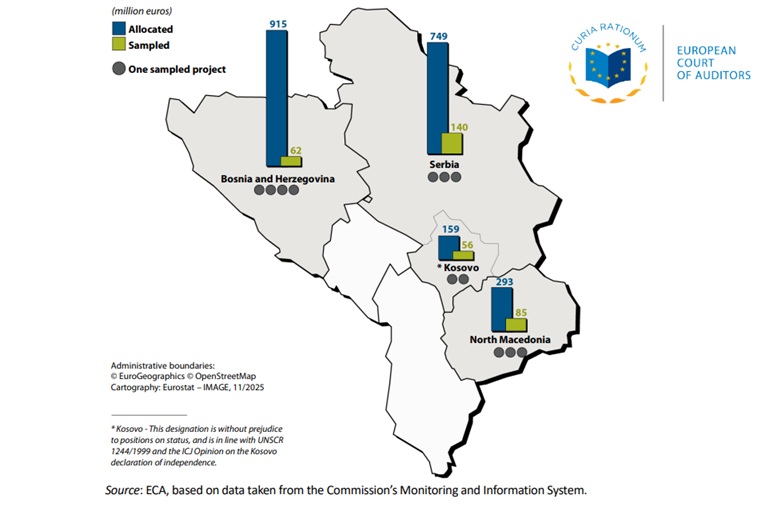
Brussels, 09 June 2026, dtt-net.com – The European Court of Auditors (ECA) in today’s report addressed criticism to the European Commission (EC), the London-based European Bank for Reconstruction and Development (EBRD) the Luxembourg-based European Investment Bank (EIB), and the World Bank, over delays it found in implementation of 2015-2025 transport projects for which the EU has paid so far €527 million.
ECA said that of 12 transport projects located in Bosnia and Herzegovina, Kosovo, North Macedonia and Serbia, it audited it found “implementation delays and operational difficulties” and the progress of the same “slowed by immature project selection and shortcomings in supervision.”
“The Western Balkans’ transport projects are progressing too slowly to connect the region to the EU this decade,” said in a press release Laima Andrikienė, the ECA Member in charge of the auditing report.
“The Commission should improve the selection, monitoring and sustainability of projects, and enhance the visibility of EU-funded transport projects in the region,” she added, over the projects from 2015 to the mid-2025 the EU body audited.
ECA auditors found “weaknesses in project selection, particularly regarding their maturity, which added to significant implementation delays,” the EU auditing body said.
“A project is mature – i.e. ready for implementation – when its preparatory work is completed and up to date. However, projects typically started with a 17-month delay. In addition, many projects faced significant delays of more than two years during implementation,” it said.
At the same time, ECA said that EU Commission has “little power” to enforce timely implementation, as it lacks effective procedures for monitoring delays, and for ensuring the sustainability and visibility of EU support.
“For example, it failed to gather information about the degree of completeness of the transport corridors it was funding, or whether transport networks complied with EU standards. It relied on financial institutions to supervise the projects, even though their work was sometimes inadequate. As a result, in certain instances it transferred amounts that exceeded those warranted by the progress projects had made. In addition, in several cases the WBIF grants – which aim to provide EU value and leverage – were not essential for raising money, as the loan contracts had been signed before the grant applications were submitted. This created a deadweight effect, as the investment would have gone ahead without the grant. At the same time, most cost estimates in the grant applications lack detail, making it difficult to assess whether they are reasonable,” reads the report.
In the report, ECA auditors also ‘raise doubts about the sustainability of several projects, for example due a lack of funds to continue with the investments and insufficient maintenance.”
“In one project, rail conditions at the time of the audit were worse than before the project started. In another, a tunnel had no connection to a road. In a third project, the railway track stopped at the border,” ECA said.
Reacting to the criticism, the European Commission said that in a press release through e-mails that “agrees with the proposed recommendations” from the European Court of Auditors to improve performance in implementation of transport projects.
“While some of the efforts for improving the effectiveness of the WBIF by selecting mature projects, strengthening the effective supervision and monitoring, and ensuring the sustainability of the investments and visibility of the EU support, are already under way, the Commission commits to full implementation of these recommendations,” the EU executive body said in its response.