

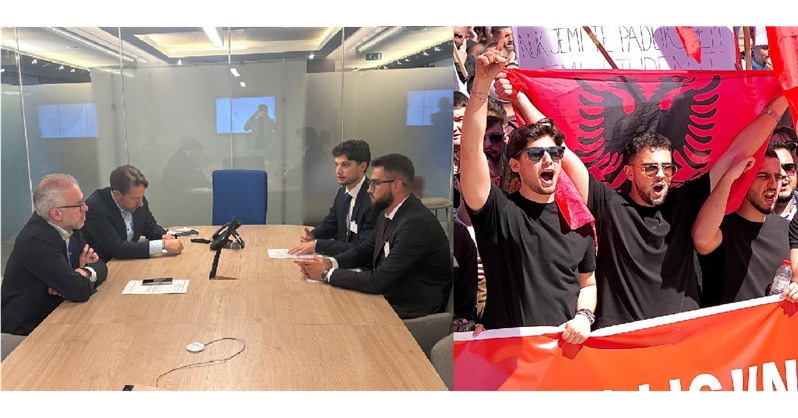
Brussels, 11 June 2026, dtt-net.com – Leaders of Albanian students movement in North Macedonia today met in Brussels with EU lawmakers, calling them and other institutions of the European bloc to address their concerns over limited use of Albanian language in public sector and overall situation of the non-majority rights in the EU candidate country, amid new disputes and tensions erupting 25 years after the armed conflict. The law student, Mevlan Ademi, and the student of IT, Çlirim Iseni, said met today with MEPs Tijs Reuten and Kathleen Van Brempt, to express their concerns over “worrying situation of non-implementation of law and constitutional rights related to the use of Albanian language in North Macedonia, as well as the lack of full implementation of the Ohrid Agreement,” of 2001, which halted the armed conflict between the former Albanian guerilla and state forces.
“We demanded that these issues be raised as a topic in the European Parliament and EU institutions, in order to address violations and delays in the implementation of constitutional obligations. Also, we stressed that the issue and position of Albanians in Northern Macedonia should be treated with priority, respecting their role as a state-forming people and a key factor in the construction and development of the state, and not simply as an ethnic minority,” Ademi and Iseni said in a press release through Facebook after the meeting with the two members of the European Parliament.
The two MEPs have not responded yet to the request of dtt-net.com over the discussion they had with the two students.
The first ever meeting of protesting students from North Macedonia with members of the European Parliament, relates first to the refusal by the Macedonian Minister of Justice, Igor Filkov of junior ruling ZNAM party, to allow Albanian students to take bar exam in mother tongue, which triggered first protest in capital Skopje in April.
A second protest then followed in May, with two other protests of support held in Albania capital of Tirana and Kosovo capital of Prishtina.
But law students are not the only one being denied the right to use their native language in bar exam. Same denials are facing other students of dozens of other faculties over their exams they need to take for their professional licences before entering job market in the EU candidate country.
Ademi announced last month that their protests are not limited to the bar and other exams, but are expanding over overall limited use of Albanian language in country’s institutions and public sector, despite the 2018 law on the use of languages, over what Albanians and Macedonians are in dispute with different interpretations over the law and specific laws related.
Earlier this month, the Deputy Prime Minister Bekim Sali (Albanian) said that a working group hired by the government is proposing partial use of Albanian language in bar exam.
According to Sali, the theoretical part of bar exam will be taken in Albanian on request of students, and practical part in Macedonian language.
Sali said that the proposal, once adopted by the government, will be send to the Venice of Commission of Council of Europe (CoE) for review, as had earlier pledged the Prime Minister Hristijan Mickoski (Macedonian).
Sali’s announcement was immediately blasted by the law student Mevlan Ademi who called for full use of Albanian language in the bar exam.
Ademi assessed government’s offer announced by Sali as “semi-solution” and “unacceptable.”
“Any attempt to offer a partial solution, a “semi-solution” or a path towards the Law on the Use of Languages is unacceptable. The Albanian language is not a negotiation matter. It is not a favour. It is not a compromise. It is a constitutional and legal right,” Ademi said in a reaction through Facebook.
The recent disputes between country’s Albanians and Macedonians, over Albanian language in the EU candidate country reflect fragile inter-ethnic relations after considerable progress made after the armed conflict.
Many Albanians in the country complain that despite progress made Albanian rights of full and free use of language has stalled in recent years.
At the same time, Albanian ruling and opposition parties continue accusing each-other of failures, with the first accusing main opposition party of failing to fully meet the promise and implement law language and other rights after 22 years of governing with Macedonian parties, and the latter accusing those in power with conservative Macedonian party since 2024 of not pushing enough to meet requests of students on language and other rights, including in proportional employment in public sector, arising from the Ohrid Agreement.