“Europe asks Kosovo about its past and Serbia about its future”
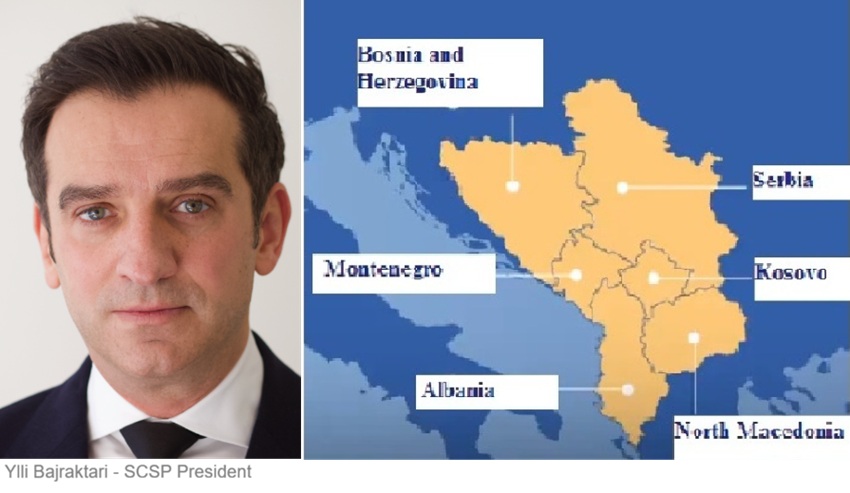
By Ylli Bajraktari, @Ylli_Bajraktari ,
Washington, 25 November 2026, dtt-net.com – In June 1999, NATO troops entered Kosovo, and people who had been driven from their homes walked back in. The generation raised on that memory drew a simple conclusion: stand with the West, and the West will stand with you. Nearly half of Kosovars are under 30, too young to remember the war. They know only the conclusion. What happens when they decide it was wrong?
In today’s geopolitical competition against Russia, China, Iran, and North Korea, small states are the scoreboard of this contest. Moscow and Beijing do not need to win the Balkans. They need only show that loyalty to the West goes unrewarded. Europe is helping them make the case, and in the age of artificial intelligence it is Europe that will pay for it.
Europe now holds two conversations in the region. With Serbia it talks about the future: investment, raw materials, accession chapters. With Kosovo it talks about the past: a war crimes court, a dialogue over the 1990s, and conditions rooted in a conflict that ended before much of the country was born.
Kosovo is asked to answer for its past
In April 2008, eight weeks after Kosovo declared independence, a Russian parliamentarian tabled a motion at the Council of Europe alleging organ trafficking by Kosovo’s liberation army. The motion led to a report, the report to a special court in The Hague, and the court became a condition of Kosovo’s European path. Kosovo’s own Assembly voted to create it.
Russia has since been expelled from that Council, the first member state ever removed. The court has outlasted its sponsor’s membership. Kosovo applied to join the same body in 2022 and won the backing of its Parliamentary Assembly, 131 votes to 29. It is still waiting for a seat.
This September the court sentenced former President Hashim Thaçi to 25 years, nearly six years after he resigned to face the charges and was taken into custody. He was convicted of murder, torture, cruel treatment, and unlawful detention. Organ trafficking, the allegation that started it all, is not among the counts. At the UN tribunal for the former Yugoslavia, the architects of the Srebrenica genocide received life. But officers convicted for their part in it received 20 and 17 years, and one received 13.
Victims of wartime crimes deserve justice, and the verdict will be tested on appeal. Those who demand accountability from every aspiring member should also accept some. The EU funds this court, along with partners including Canada, Norway, Switzerland, and Türkiye. Would any of them accept, in their own jurisdiction, nearly six years of detention before a first verdict?
Kosovo did what Europe asked. Its membership application, filed in December 2022, has never been sent to the Commission for an opinion. It remains the only country in the region without candidate status.
Serbia is asked only about its future
Serbia does not sanction Russia, and the movement that won its October election says it will not start. It negotiates EU membership all the same. In the years Brussels came to treat Beijing as a systemic rival, Serbia became the first country in Europe to join Xi Jinping’s “community with a shared future“ and the first to field a Chinese air defense system.
The European Commission’s 2026 report found that Serbia “has yet to show genuine commitment“ to investigating and adjudicating war crimes. A Serbian human rights group counted at least 110 denials of 1990s war crimes by the authorities last year, the massacre at Račak and the mass graves at Batajnica among them. When Ratko Mladić was buried in Belgrade this September, flown home on a state plane to a military honor guard, the Commission’s president said she was “horrified by the images“ and announced no measures. Serbia’s talks have stalled over democratic backsliding, yet no reckoning with the past has been set as the price of progress, as it was for Kosovo.
Accountability is right, and Europe should demand it. The failure is in who gets asked. Europe demands a reckoning from the smaller, loyal party and waives it for the larger one that hedges. Belgrade’s leverage comes from its option to turn east. Kosovo has no such option and wants none.
Europe has not tried to understand Kosovo
Walk through Prishtina and count the flags. The European Union’s flag flies beside the American and the Albanian on public buildings, in squares, and in shop windows. I know of no country outside the Union that displays it more. Kosovars put it there themselves, for a club that has yet to open their application.
By Gallup’s measure, Kosovo is also the most pro-American country on earth. In a year when global approval of U.S. leadership fell to 31 percent and China’s edged ahead, Kosovars were the public most aligned with the United States of any surveyed: net approval of plus 64 for Washington and minus 68 for Beijing.
Kosovo acts on those convictions. It sanctioned Russia in 2022, sent instructors to train Ukrainian soldiers, and pledged trucks, armored vehicles, and mortar shells, all for a country that does not recognize it. When the United States struck Iran this year, Kosovo’s leaders backed it within a day. When Washington asked for partners on Gaza, Kosovo and Albania were the only Western Balkan governments to join the Board of Peace, while Berlin, Paris, and most EU capitals stayed out.
In European capitals that reflex wins Kosovo no credit, and in my experience it sometimes carries a cost. It is proof that when the West is tested, Kosovo shows up.
The new Kosovo is building what Europe says it wants
While Europe studies Kosovo’s past, it is missing Kosovo’s present. Two years ago in this newsletter, we described Kosovo’s journey from nation building to a start up nation. Last week I saw how far it has come.
In a single week this November, Prishtina hosted a forum on AI and national security that SCSP helped organize, an AI conference, and the European Defense Tech Hackathon. The hackathon opened at the headquarters of Kosovo’s Ministry of Defense and drew some 200 engineers and defense specialists to build dual-use technology. Its organizers call it the first of its kind in the country, and by their account in the Balkans. The people in those rooms are in their twenties, and they speak English as if they were born to it. The culture is impatient, technical, and optimistic. It reminds me more of Silicon Valley than of Brussels.
The results are real. Companies started by Kosovars, such as hellocare.ai in health AI and Tive in supply-chain technology, now compete globally and use engineers based in Pristina. Business services exports quadrupled in four years, and Kosovo ranks third in the world, behind only India and Poland, on a leading index of outsourcing confidence. Notice where the most successful of those companies are now headquartered: the United States. American capital has already seen what Europe has not.
Kosovo pairs this with competitive elections, a press that climbed 15 places in this year’s global freedom rankings while conditions across the rest of the region worsened, and a civil society that debates loudly and often. The institutions are imperfect, and the courts above all need work. But talent, openness, and democratic habits in one place at one time is a combination Europe will not easily find elsewhere in the region.
In the AI era, talent is the scarce input. Compute can be bought and capital can be raised. Young people who can build, who want to work with the West, and who believe in democratic technology cannot be manufactured. Europe’s answer has been to take that talent one emigrant at a time while keeping the country at arm’s length.
Brussels believes it is making Kosovo wait. It is making itself smaller.
Europe should change the question
None of this is an argument for Kosovo to walk away. Eighty-nine percent of Kosovars say they would vote to join the EU, a margin few member states could match, and Europe has funded much of Kosovo’s state-building. Nor does it diminish the partner that made Kosovo possible. America acted in 1999, recognized Kosovo in 2008, and anchors its security today. The European path and the American partnership are complements. One is where Kosovo is going. The other is why it can get there.
Four things follow.
Change the question. The Council should send Kosovo’s application to the Commission and let it be judged on what the country is becoming.
Settle recognition. The EU should ask its five members that do not recognize Kosovo (Cyprus, Greece, Romania, Slovakia, and Spain) to accept reality and move on. Europe cannot consolidate the continent while five of its own members dispute a neighbor’s existence. Recognition would also tell Serbia that the past is over and that the two countries must move forward separately.
Apply one standard. Europe should hold Serbia to the standard on the past that it has applied to Kosovo.
Repair the American relationship. Kosovo’s government has its own work to do, and it starts with America, the main guarantor of Kosovo’s independence. Washington suspended its strategic dialogue with Prishtina last year. Repairing that relationship is Prishtina’s first task.
Kosovo now has a new President and a newly elected Prime Minister. With the right approach from Brussels, this could begin a new era, one that brings Kosovo to where its heart, its soul, and its mentality belong.
Europe keeps asking Kosovo where it has been. It already asks Serbia where it is going. Kosovo, of all countries, has earned the second question.
About the author: Ylli Bajraktari is an American national security policy expert who serves as President and CEO of the Special Competitive Studies Project (SCSP), a private operating foundation located in Arlington, VA. Prior to launching SCSP, Ylli served as the Executive Director of the National Security Commission on Artificial Intelligence. Prior to joining NSCAI, he served as Chief of Staff to the National Security Advisor LTG H.R. McMaster, held a variety of leadership roles for former Deputy Secretary of Defense Robert Work, and served as Special Assistant to the Chairman of the Joint Chiefs of Staff, General Dempsey.
This opinion was published originally at SCSP Subtack page.
The views and opinions expressed in this article are those of the author and do not necessarily reflect the official policy or position of dtt-net.com.