

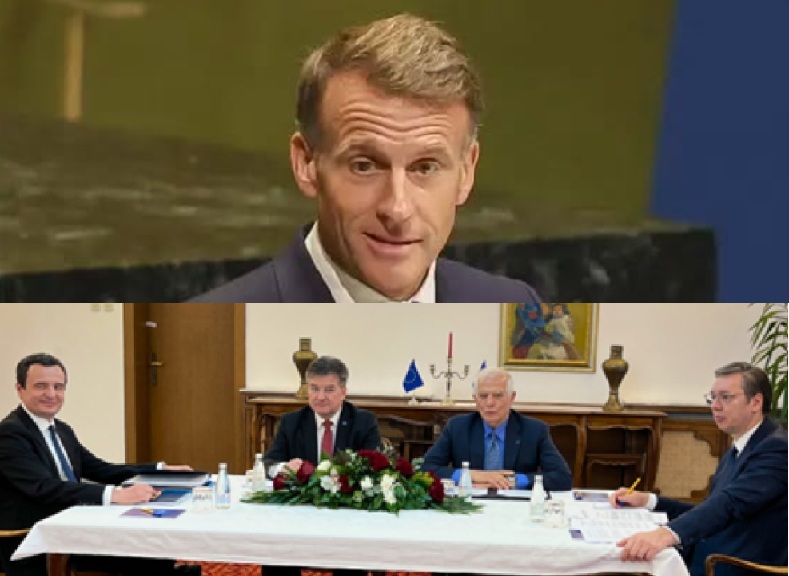
Paris/Prishtina, 04 November 2026, dtt-net.com – The President of France, Emmanual Macron, has renewed his and EU calls to Kosovo and Serbia to implement the Brussels-brokered verbal agreement of 2023, focused on the controversial autonomous body for Serb minority, pushed also by Serbia and Russia, but opposed by a landslide majority of Kosovo citizens fearing paralysis and dysfunctionality of the new state similar to the Bosnia model of ethnically and administratively divided country since 1995 Dayton Peace deal.
Macron made his renewed call in a letter a week ago, when he congratulated newly elected President of Kosovo, Justina Shiroka-Pula.
“I wish to underscore the vital importance of normalizing relations between Kosovo and Serbia. The Brussels – Ohrid agreements have set the course, and France will continue to support the dialogue facilitated by the European Union. It is now up to both parties to implement the commitments they have made,” French President wrote in the letter published by Shiroka-Pula office, over the deal which is centred on the German-French proposed statute for the what is named “Association of Serb-majority Municipalities- ASM’ presented to the Prime Minister of Kosovo Albin Kurti in October 2023, by Macron himself, the former German Chancellor Olaf Scholz, and leaders of EU institutions in Brussels.
Many in Kosovo fear that if the ASM is formed according to the EU-proposed statute of October 2023, the country will be transformed into a second Bosnia-type of paralysed system on ethnic basis and ethnic administrative lines.
A clear majority of Kosovo Albanians say that formation of ASM, pushed by the EU and Serbia and backed by Russia too, would destabilize Kosovo, according to a new opinion survey of July last year..
68,84 percent of Kosovo Albanians say they are concerned that the ASM, could lead to “increase of autonomy for Serb-majority areas and potentially destabilize Kosovo”, according to the survey presented by the local NGO CASA.
Another survey of last year of 2024 said that 81% of Kosovo citizens are against formation of the ASM.
Kurti insists that Serbia should meet three conditions in order the deal he reached with the former Serbia’s President Aleksandar Vucic can be implemented, thus ASM be formed.
He says that Serbia should withdraw the letter of September 2023, in which Belgrade rejects the part of the unsigned agreement which refers to the recognition of Kosovo’s territorial integrity and its membership in international organizations; handover the leader of Serbia-backed gunmen which attacked Kosovan police in September 2023 and the agreement be signed by both sides.
Serbia’s former President Aleksandar Vucic has refused Kurti’s conditions.
The EU says that there is no need for signature and continues to press Kurti to form the controversial ASM asking him to send the proposed statute to the Constitutional Court for review.
But Kurti rejects the call and says his three conditions should be met first by Serbia; in order implementation of the deal can happen, thus the ASM proposed be formed.
Following the toppling of Vucic and his Progressive Party (SNS) in October 25 elections, the situation over the EU-mediated deals and the push by the EU for the autonomous body remains enigmatic, as leaders of Students List in Serbia are refusing to unveil their position over the matter for the time being.
The medicine doctor and professor at the faculty of Niovi Sad, Ilija Srdanović told Radio Free Europe (RfE) last month in Serbian language, that the EU-mediated agreements between Vucic Kurti, will be checked if are in line of Serbia’s Constitution.
“All protocols that our officials have agreed on behalf of Serbia can be, it doesn’t have to be, but they can be reviewed in terms of whether they are in line with the Constitution of the Republic of Serbia,” he said.
The Constitution of Serbia treats Kosovo as integral part of Serbia, while the 2023 basic verbal agreement says that both sides are “aware that the inviolability of frontiers and respect for territorial integrity and sovereignty and the protection of national minorities are a basic condition for peace.”

