

( Written and edited by Ekrem H. Krasniqi, @E_H_Krasniqi )
Brussels, 04 November 2026, dtt-net.com – The European Union’s executive branch is doing “quite a lot” behind the scenes to break a four-year stalemate blocking North Macedonia’s EU accession talks, according to the bloc’s enlargement chief.
The deadlock stems from deep-rooted disputes over Macedonian identity and language, which Bulgaria refuses to recognize. However, as Brussels claims quiet progress, scepticism from Macedonian Prime Minister Hristijan Mickoski is growing over whether a solution can ever be found.
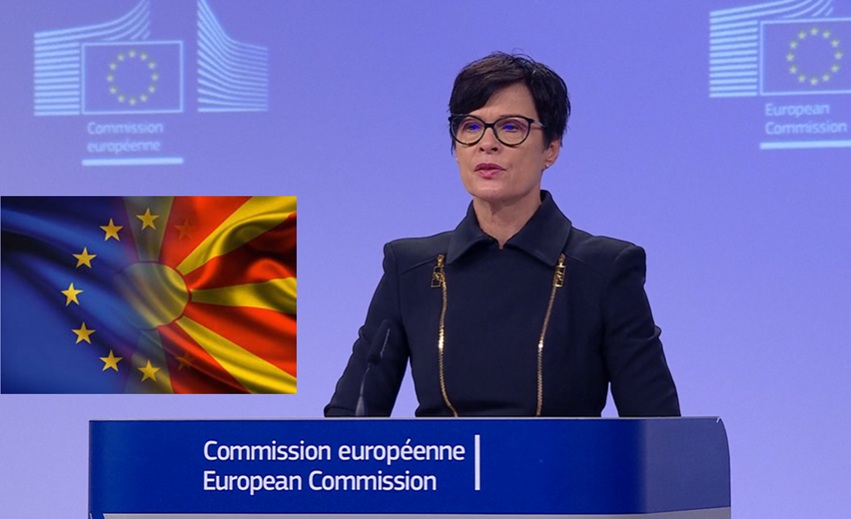
“Oh yes, we are doing quite a lot for the relations between North Macedonia and Bulgaria, but we don’t tell everything,” Slovenian European Commissioner for Enlargement Marta Kos stated briefly today.
She was responding to questions from the dtt-net.com agency regarding why the European Commission has not openly mediated between the neighbouring countries.
The remarks follow a public call for EU mediation made by Mickoski last month, just a day before European Commission President Ursula von der Leyen arrived in Skopje.
During that visit, Von der Leyen suggested that Mickoski’s government directly request meetings with Bulgarian counterparts. While Skopje has pursued such meetings throughout the year, the efforts have yielded no success.
With both sides dug into their positions, Mickoski warned two weeks ago that a breakthrough remains highly unlikely due to Bulgaria’s ongoing denial of Macedonian identity and language recognition that is vital to unlocking the country’s EU path.
“If they really want to see a neighbour who will be part of the European Union, and not a neighbour from whom they will demand a solution to issues from the 11th century, the 10th century, the Middle Ages… unfortunately, we do not have living people to witness what happened then,” Mickoski told local TV21 on October 15.
“Based on the historical facts that we read, we and they have different interpretations. So, as long as these bilateral barriers exist, it is unlikely that we will find a solution,” the conservative premier added.
The root of the current EU requirement dates back to 2022. Imposed by Sofia and accepted by Skopje’s previous social-democrat-led government, the EU framework mandates that North Macedonia amend its constitution to officially include the Bulgarian community.
However, Mickoski and his ruling VMRO-DPMNE party refuses to provide the necessary parliamentary votes for these constitutional changes without formal guarantees from the EU. The party demands ironclad assurances that Sofia will not impose further conditions regarding Macedonian culture, language, and history, and that Bulgaria will respect the rights of the Macedonian minority within its own borders.
In September, Mickoski indicated a willingness to pass the constitutional changes stipulated in the 2022 negotiating framework, but with a strict caveat: the amendments would only take effect after all 27 EU member states ratify North Macedonia’s final accession treaty.
Prior to this proposal, the Prime Minister had put forward two specific counter-conditions for implementing the constitutional changes demanded by Bulgaria and backed by the rest of the bloc.
First, he demanded that Sofia respect the rights of the Macedonian community in Bulgaria.
Second, he called on both Bulgaria and the EU to provide official guarantees that no additional demands regarding Macedonian identity and language would be brought forward during future accession talks.
As it stands, North Macedonia remains firmly blocked on its promised path toward EU membership. The country’s largest political force refuses to succumb to conditions from Sofia and Brussels without securing formal protections for the Macedonian language and identity which Bulgaria continues to dismiss as a mere dialect of Bulgarian.

