

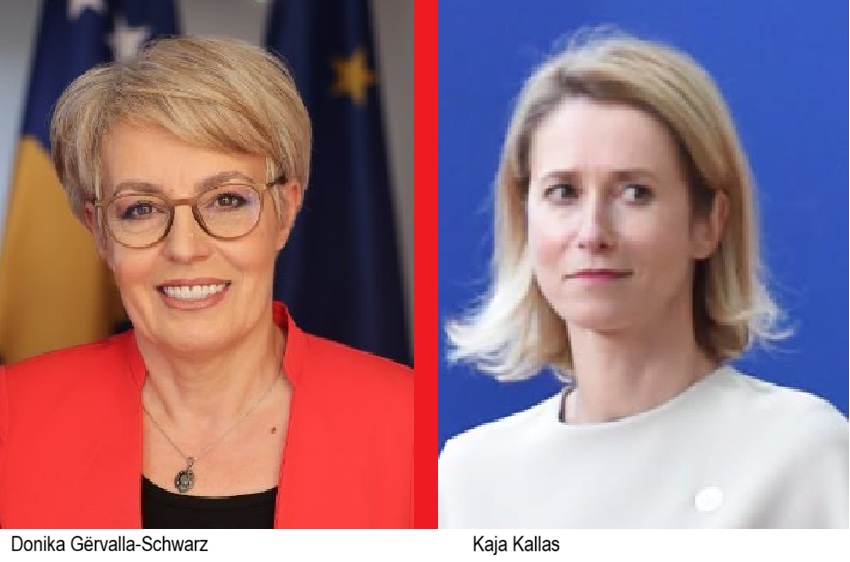
Prishtina/Brussels, 29 August 2026, dtt-net.com – The office of the EU chief of diplomacy, Kaja Kallas, yesterday criticised Kosovo judicial body for rejecting withdrawal of resignations of Kosovan Serb judges and supporting staff when they were ordered by Serbia government to quit jobs massively in 2022, but Kosovo Minister of Justice today hit back today saying that there is no law which allows those who were absent at their jobs for four years to have them back at their will, arguing that rejection of their return is exactly implementation of law and not the opposite.
A spokesperson of the EU external action (EEAS) run by Kallas yesterday said that Kosovo laws were breached by the Kosovo Judicial Council (KJC) after on Thursday it rejected July withdrawals of resignation of November 2022 by dozens of Serb judges and administration staff, same as it did with prosecutors in four Serb-predominantly municipalities.
“Those decisions appears incompatible with Kosovo law, due process and overall rule of law requirements in Kosovo,” the EEAS of Kallas said.
But Minister Donika Gervall strongly dissagreed and accused the EEAS office of political pressure in dissregard of Kosovo laws when it comes to the case of Serb judges and prosecutors resignations, ordered by Serbia.
“As Minister of Justice, I cannot remain silent in the face of efforts to question the implementation of the law of the Republic of Kosovo by its independent institutions and to impose on them anyone’s interpretations and political preferences,” Gervalla said in a public protest.
She said that the Serbian judges have not exercised their duties for approximately four years and have been disconnected from the regular processes of the Kosovo judicial system, including reporting, performance evaluation, ongoing training and other obligations that apply to all judges.
“Continued absence from work constitutes a serious disciplinary violation under the applicable Law on Disciplinary Responsibility of 2018. This, together with other violated legal obligations, makes the withdrawal of these resignations unacceptable in the current circumstances,” said Minister Gërvalla, adding that their resignations during 2022 were not individual and isolated actions.
“They were given in an organized manner, along with resignations from other positions in justice institutions, under circumstances of political pressure directed by the Serbian state,” she said, adding that such an action contradicts the laws of Kosovo.
“Therefore, I publicly challenge anyone who claims that these decisions contradict the law of the Republic of Kosovo: tell us which law has been violated. Which article? Which provision? Tell us which law of the Republic of Kosovo determines that a person can resign from a function in the justice system, not exercise that function for approximately four years and then return to the same position?. If a violation of the law is alleged, then let the exact law that has been violated be indicated”, Minister Gërvalla said.
She said that it is “unacceptable that today a decision of the Judicial Council, based on the constitutional and legal framework of the Republic of Kosovo, is questioned for political reasons.”
“Kosovo cannot be required to implement the law and, at the same time, pressure can be exerted on its institutions when they implement it,” said Minister Gërvalla.
Expressing her support for the KJC decision, Minister Gërvalla reiterated the importance of representing all communities in justice institutions, emphasizing that this principle cannot be used to relativize the law.
“Our European partners must support the rule of law in Kosovo not only when the results are politically convenient, but precisely when independent institutions make decisions based on the law,” she said.
Gervalla also accused the EU of appeasement toward Serbia leadership and its Serb List party in Kosovo.
She said that Kosovo “cannot sacrifice the rule of law for the sake of the appeasement policies of the EU, to the detriment of the constitutional and legal order of the Republic of Kosovo.”
“In the Republic of Kosovo, no one is above the law. Absolutely no one! No individual. No institution. And no political pressure, local or international,” she concluded.
Nearly 600 Kosovan Serbs local police force, its administration, customs, judges, and prosecutors, had quit their jobs upon orders of Serbia’s government.
The massive resignations of November 2022 were done after consultations with Serbia’s leadership in protest of a sacking of a regional Serb police director, who refused to implement a decision of Kosovan government to issue warnings to local Serbs who refuse to obtain Kosovo issued vehicle licence plates and use those issued by Serbia instead.
The resignations, including of four mayors of municipalities, all four from the Serbia-backed Serb List, was especially a way of pressure by Belgrade on Kosovan authorities to form an autonomous body for ten Serb-predominantly municipalities with special and executive powers, which Kosovan government still resists forming.
In February 2023, Kosovan Prime Minister Albin Kurti and Serbian President Aleksandar Vucic, reached an EU-brokered deal in Brussels, which focuses on formation of what is named “Association of Serb-majority Municipalities – ASM”, for additional powers in economy, finances, urbanism, police, education, healthcare, and culture.
The deal of February 2023 reached in Brussels and then implementation annex in Ohrid of North Macedonia of March 2023, is part of the EU-mediated talks between the two sides aimed at what western powers call “normalization” of relations.
Formation of ASM is the core of the agreement not signed so far by the two sides.
The EU has proposed the ASM statute in October 2023, but the body is still not being formed.
Many in Kosovo fear that if ASM is formed the country will be transformed into a second Bosnia-type of paralysed system on ethnic basis and ethnic administrative lines.
68,84 percent of Kosovo Albanians say they are concerned that the ASM would lead to “increase of autonomy for Serb-majority areas and potentially destabilize Kosovo”, according to the survey presented by the local NGO CASA last year.
Another survey of 2024 said that 81% of Kosovo citizens are against formation of the ASM.
Kurti has earlier said that Serbia should meet three conditions in order the 2023 deal he reached with Vucic can be implemented, thus ASM formed as proposed by the EU.
He has said that Serbia should withdraw the letter of September 2023, in which Belgrade rejects the part of the unsigned agreement which refers to the recognition of Kosovo’s territorial integrity and its membership in international organizations; handover the leader of Serbia-backed gunmen which attacked Kosovan police in September 2023 and the agreement be signed by both sides.
Vucic refuses to sign the agreement, which was supported by the Joe Biden’s government, but ignored by Donald Trump’s government so far.
The EU says that there is no need for signature and continues to press Kurti to form the controversial ASM and is pressing him to send the proposed statute to the Constitutional Court for review. But Kurti rejects the call and says his three conditions should be met first by Serbia, which President Aleksandar Vucic refuses to do.
