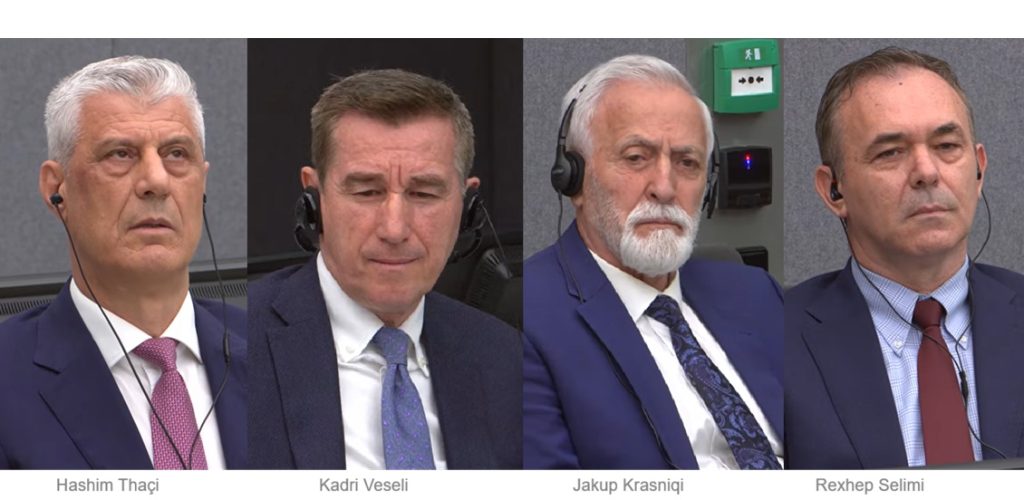
The Hague/Prishtina, 16 September 2026, dtt-net.com – The former President of Kosovo and three other former leaders of Kosovan Albanian guerilla (KLA) which fought during the 1998-1999 war for liberation and independence from Serbia, today were found guilty and sentenced of war crimes charges by judges of the special court in The Hague.
American Judge Charles Smith announced that the panel of judges sentences Hashim Thaçi to single sentence of 25 years of imprisonment, Kadri Veseli to 18 years, Jakup Krasniqi to 25 years and Rexhep Selimi to 13 years for being responsible on charges of “arbitrary detention of 385 individuals (Albanian and Serbs); cruel treatment against 49 individuals; torture against 303 individuals and murder against 96 individuals” in Kosovo and northern Albania by members of the KLA they were leaders of.
The sentences take credit of their times served in The Hague court since 2020 detention.
According to the verdict, the victims were Albanians and Serbs considered by the Kosovo guerilla members of being collaborators of Serbia, spies and traitors.
According to the indictment, the crimes charged they are found guilty were committed from at least April 1998 to June September 1999 and took place in several locations across Kosovo as well as in Kukës and Cahan, in Northern Albania.
All four have denied the charges.
Two other former KLA members are already sentenced to prison terms in separate trials in The Hague.
The prosecution of the special court, made of international prosecutors and judges, has sought 45 years of imprisonment for each of the four former KLA leaders.
Earlier this month the prosecution sought additional 6 years of imprisonment for Thaçi on charges of pressure on witnesses during the trial.
Formation of the EU-sponsored and USA-backed special court was triggered by a report of the late Swiss politician, Dick Marty, adopted in 2011 by the Parliamentary Assembly of the Council of Europe.
Marty said in his report that Thaçi, the former speaker of Parliament Kadri Veseli, Jakup Krasniqi, also a former Speaker of Parliament, and former member of the Parliament Rexhep Selimi, engaged in human organ harvesting of Serb and Albanian civilians during and after the 1998-1999 war, which they have denied.
The indictments by the prosecution have not included human harvesting allegations by Marty.
The four have the right to appeal the verdict of the court, which many in Kosovo treat as “mono-ethnic” and of “selective justice” imposed by the EU and former USA government.
The office of the prosecution has ignored war crimes committed by Serbia army, police and paramilitaries on ethnic Albanian civilians during the 1998-1999 war, despite that the fact EU-27 governments have said seven years ago that existing legal framework enables investigation and prosecution of “all alleged war crimes”.
The EU Council of Ministers in June 2019 said that the law of August 2015 of Kosovo parliament, with which the court was formed after pushed to change the Constitution to pave the way for the law, enables the court to tackle all crimes, including those committed by the regime of the then President of Serbia, Slobodan Milosevic.
Nearly 13,000 Albanian civilians were massacred by Serb forces, 20,000 girls and women raped, 120,000 houses destroyed and more than 800 000 deported forcibly to Albania and North Macedonia during the two-year war by Serbia forces.
“The existing legal framework enables proper investigation and prosecution of all alleged war crimes,” reads the text of conclusions of the EU Council of 18 June 2019.
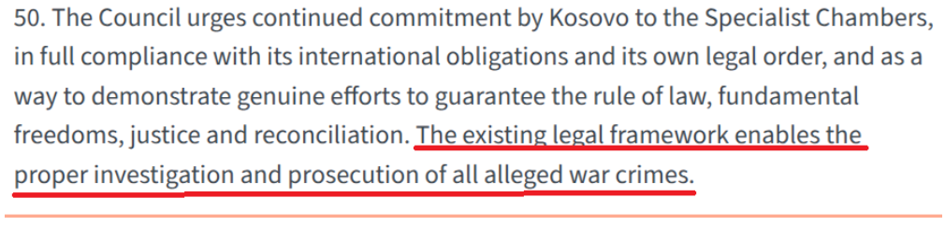
But no charges are filed by special court’s prosecution against any members of Serbia forces, despite.
Around 1500 civilians are still missing from the two-year war, of which around 500 Serbs believed to be killed by KLA members in revenge.
Thousands gathered in capital Prishtina, awaiting verdict of today and in support of the four.
Western officials have expressed concern of possible tensions in Kosovo over today’s guilty verdict.
NATO top officials have said that the peacekeeping force KFOR is there to ensure stability in case of unrest.
Following the verdict, hundreds of citizens supporters of Thaçi and KLA went to the premises of the EU rule of law mission (EULEX) guarded by a cordon of Kosovo police throwing stones toward the building. Another group then turned to the government building also guarded by police cordon.
In The Hague, in front of the court premises, thousands of others protested and briefly clashed with Dutch police, with two of them detained and one policeman injured, according to the media reports.