

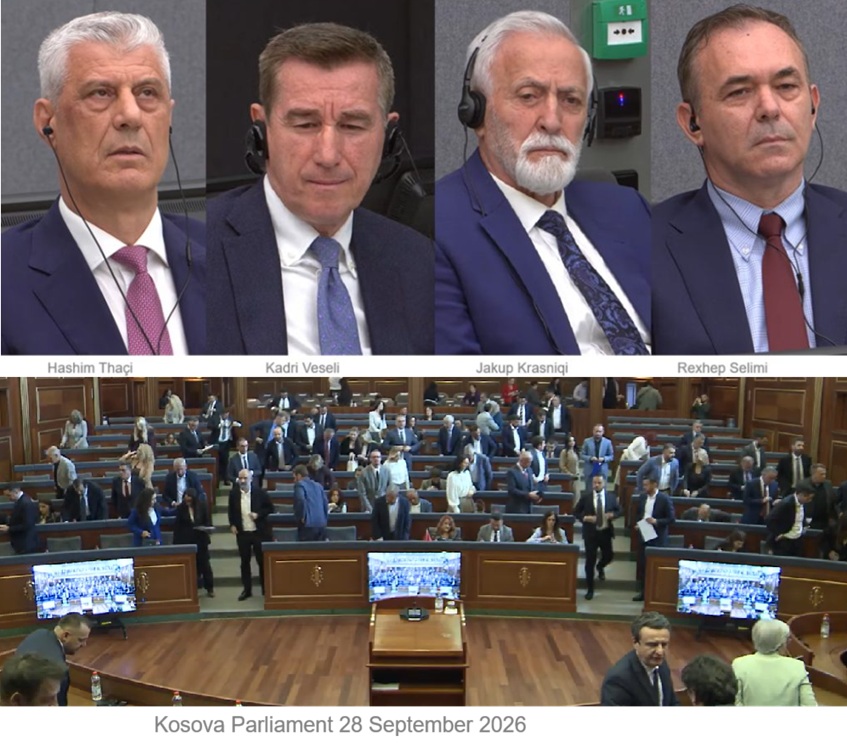
Prishtina, 28 September 2026, dtt-net.com – ruling and opposition parties of Kosovo adopted a declaration in attempt to preserve and defend to the world public the liberation and independence purpose and goal of the now disbanded guerilla of the war against Serbia army, police and paramilitaries, following recent sentencing of its former leaders by European and American judges on war crimes charges, but the very same politicians are in in discord to avoid third early elections and fourth in total in last two years.
99 lawmakers present at today’s session called for the statement, the lawmakers expressed disapproval to the verdict, especially the ruling of the panel of judges over what it said “existence of a common criminal intent unacceptable” and said such conclusion of judges of the court in The Hague is “unacceptable,” as former fighters led by Hashim Thaçi and three others found guilty to total 81 years of imprisonment by the first ruling was to liberate Kosovo from Serbia.
The Kosovo parliament “OPPOSES any attempt to subvert the historical truth of Kosovo, to question its liberation war, or to equate the people who fought for freedom and survival with the regime that oppressed them,” reads the text adopted today in an urgent session pushed by the Democratic Party of Kosovo (PDK), the party formed by Thaçi, Jakup Krasniqi, Kadri Veseli and Rexhep Selimi in 1999 after the war ended in June that year.
“The truth of the liberation war, justice for the victims and their families, and the right of the convicted to a fair trial belong to the same Republic. The Assembly will defend all three without compromise,” the statement concluded.
Ten days ago, Thaçi and three others to total 91 years of imprisonment, of which Thaçi and Krasniqi to 25 years each, Krasniqi to 18 and Selimi to 13 on charges of war crimes during the 1998-1999 war of KLA for liberation and independence from Serbia.
According to the judges they were part of criminal enterprise, but with individual responsibility, for the charges they are sentenced.
PDK, founded and led by Thaçi and Kadri Veseli until 2020, when they voluntarily handed over themselves to the court for trial, last week sent proposals to the parliament for the law changes, hoping to obtain acquittal of the four in Prishtina court if the appeal chamber in the Hague, made of European and American prosecutors and judges too, would order a retrial after an appeal is made by the defence.
According to the PDK party, changes forwarded to the parliament would limit the mandate of the court and retrial – if decided by appeal court – while further procedures would be transferred to local courts in Kosovo.
For cases currently in process, the draft-law foresees that the proceedings will continue in the Appeals Court according to the existing structure of the Specialist Chambers and in the event that the Appeals Court orders a retrial, according to Hamza explanations, it would be conducted under the new jurisdiction [if changed by Kosovo parliament], and when the conditions are met, the case would be transferred to Kosovo territory.
The Prime Minister Albin Kurti has still not made a clear public response to the law changes wanted by the PDK, as both sides are having daily talks also on how to end the stalemate on completing constitution of parliament after June early elections and elect a new President of the country.
The PDK has offered publicly support for electing new President, if Kurti would agree to support the EU-written law on special war crimes court.
Kurti is not making clear his intentions, however so far, although he has accused opposition parties of not supporting his candidates for the post.
The PDK is in urgency to get changes of the law on special court, and has offer its votes for Kurti new eventual list of candidates, as a first one agreed by Kurti and the leader of the Democratic League (LDK) Lumir Abdixhiku did not get sufficient support even within LDK 18 lawmakers.
But the verdict on former leaders of Kosovo Liberation Army (KLA) over 1998-1999 war by the judges of the special court paid by the EU and USA taxpayers money, has changed the position of the PDK totally over the institutional stalemate of since last year, after regular February elections of 2025, respectively.
Nearly 13,000 Albanian civilians were massacred by Serbia forces, 20,000 girls and women raped, 120,000 houses destroyed during the war and more than 800 000 deported forcibly to Albania and North Macedonia during the two-year war.
Around 1500 civilians are still missing, of which around 500 Serbs believed to be killed by KLA members in revenge.
Last week, the EU-sponsored special court in the Hague, with European and American prosecutors and judges, found guilty and sentenced former Kosovo President Hashim Thaçi and three other former leaders of Kosovo guerilla (KLA) to total 81 years on war crimes, of which Thaçi 25 years.
Formation of the EU-sponsored and USA-backed special court was triggered by a report of the late Swiss politician, Dick Marty, adopted in 2011 by the Parliamentary Assembly of the Council of Europe.
Marty said in his report that Thaçi, the former speaker of Parliament Kadri Veseli, Jakup Krasniqi, also a former Speaker of Parliament, and former member of the Parliament Rexhep Selimi, engaged in human organ harvesting of Serb and Albanian civilians during and after the 1998-1999 war, which they have denied.
The indictments by the prosecution have not included human harvesting allegations by Marty.
The four have the right to appeal the verdict of the court, which many in Kosovo treat as “mono-ethnic” and of “selective justice” imposed by the EU and former USA government.
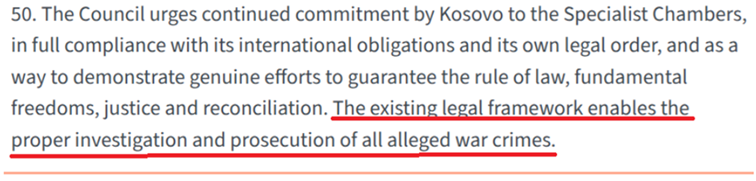
The office of the prosecution has ignored war crimes committed by Serbia army, police and paramilitaries on ethnic Albanian civilians during the 1998-1999 war, despite that the fact EU-27 governments have said seven years ago that existing legal framework enables investigation and prosecution of “all alleged war crimes”.
The EU Council of Ministers in June 2019 said that the law of August 2015 of Kosovo parliament, with which the court was formed after pushed to change the Constitution to pave the way for the law, enables the court to tackle all crimes, including those committed by the regime of the then President of Serbia, Slobodan Milosevic.
“The existing legal framework enables proper investigation and prosecution of all alleged war crimes,” reads the text of conclusions of the EU Council of 18 June 2019.
But no charges are filed by EU and USA sponsored prosecutors against any members of Serbia forces, despite.
