By Andrew Rettman,
Brussels, 08 September 2026, dtt-net.com / euobserver.com – “The EU is feeding the little octopus [Serbia] to try to pull it away from the giant one [Russia],” Kosovar politician (and now prime minister) Albin Kurti told EUobserver in Pristina in September 2011, in his assessment of the EU’s enlargement strategy in the Western Balkans at the time.
The EU has been feeding Serbia some €1.5bn a year since it became an accession candidate in 2012.
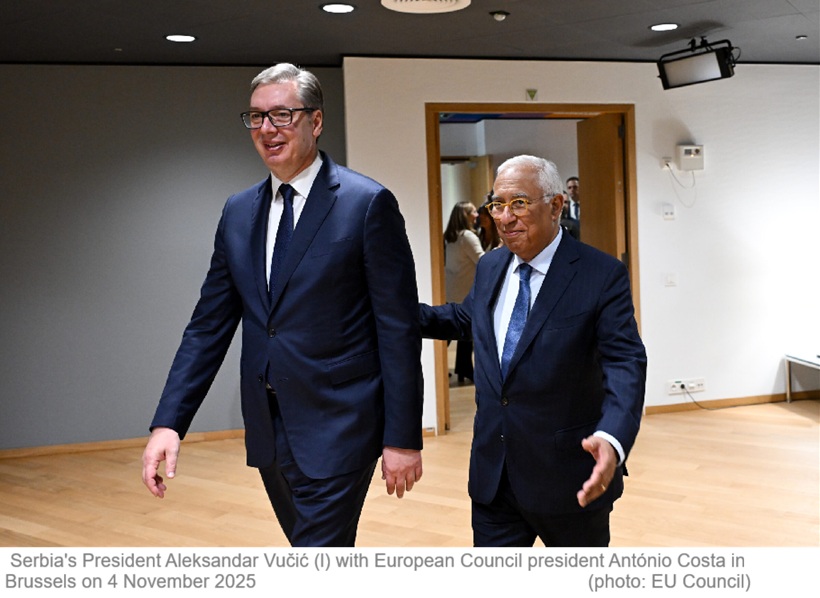
It has also opened 22 out of 35 EU accession-talk ‘chapters’, rolled out the red carpet for Serbian president Aleksandar Vučić in over 10 summits, and given some 6.5m Serbs visa-free access to Europe.
But Serbia’s quasi-state funeral and popular outpouring of grief in Belgrade on Monday (7 September) for the general who did the 1995 Srebrenica genocide, Ratko Mladić, exposed that there was still a grotesque, regressive nationalism lurking below the surface in Serbian society, which was quite at odds with EU values.
And despite the risk of Russian and Israeli interference on Vučić’s side, snap elections in October will test still further if Serbs really want change by throwing him out of power, the same way Hungarian voters did prime minister Viktor Orbán in April, or not.
Kurti, the Albanian prime minister, is known for his pungent rhetoric.
But his octopus analogy was not intended to dehumanise Serbs, rather than to note that hardcore nationalists in Belgrade also had tentacles of influence in the Serb diaspora in Bosnia, Kosovo, North Macedonia, and Montenegro, making the extremists key to regional stability.
Funeral no-show
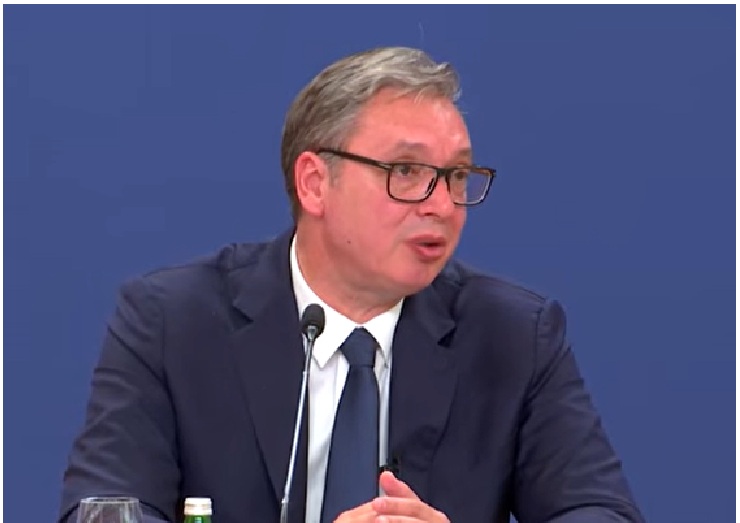
Vučić did not go to the funeral that he let go ahead, but his son, his defence minister, his justice minister, his culture minister, Bosnian Serb politician Milorad Dodik, Russia’s ambassador to Serbia, and thousands of Serbs did attend the Mladić rites, led by Serb Orthodox patriarch Porfirije.
The EU had already frozen the opening of new Serbia accession chapters since 2021 and held back €1.5bn in funding in May this year due to Vučić’s democratic backsliding.
And the funeral saw top EU officials voice “shock” on X and cancel upcoming trips to Belgrade, while Austrian MEP Helmut Brandstätter, who deals with the Western Balkans, said: “No more [accession] talks and no [EU] money if the Vučić regime keeps on admiring war criminals – and continues to hunt students and freedom fighters in the streets and via wiretapping”.
“There is no place in Europe for the glorification of war criminals,” also said EU chief diplomat Kaja Kallas.
Vučić called the snap election (for 25 October) also on Monday in reaction to a long-running, student-led protest over government corruption, which had caused the lethal collapse of a railway station roof in the town of Novi Sad in November 2024.
And police violence aside, student leaders’ phones have been targeted with ‘Pegasus’ spyware, which Israel typically sells to friendly regimes.
The student protest won broad support among young and old, urban and rural, middle-class and working-class Serbs, showing the progressive side of the Western Balkan’s dominant power.
But so too did the Mladić funeral, showing a deep cultural and political dissonance some 40 years after Mladić and his kind began the Yugoslav Wars in 1991.
Meanwhile, if the EU strategy was to fail, then the octopuses might multiply.
Vučić and Dodik could give birth to an independent Republika Srpska in future, breaking up Bosnia, which risked inspiring other Western Balkan ethnic exclaves to also break their post-war accords.
Manufactured instability
Manufactured Western Balkans instability would suit Russian president Vladimir Putin to pressure the EU to abandon Ukraine, in an extension of his hybrid warfare escalations against Nato.
Recognising an independent Republika Srpska would suit Israel – to impose a cost on the EU for any potential sanctions, the way Israeli ministers did with the UK on Tuesday, by calling to recognise Argentina’s claim to the Falkland Islands.
The Mladić funeral saw Bosnian foreign minister Elmedin Konaković pull diplomats from Belgrade in protest, escalating tensions in Sarajevo, which Vučić must have foreseen would happen.
Dodik has hired a Canadian-Israeli lobbying firm, Dickens & Madson, and a US advocacy group, The Gold Institute for International Strategy, to curry favour with US president Donald Trump, who dropped sanctions against him already.
And another Bosnian Serb leader, Željka Cvijanović, met with Israeli prime minister Benjamin Netanyahu in Jerusalem on 22 June, while Netanyahu opened a chamber of commerce in the Republika Srpska capital, Banja Luka, on 3 September, in a sign of what may be to come.
The 56-year-old Vučić was himself the “information minister” for former Serbian dictator Slobodan Milošević’s pogroms during the 1998 to 1999 Kosovo War, meaning that he also hid a dark personality underneath his manicured, EU summit-VIP veneer.
He has held power since 2017, in a populist and increasingly authoritarian style of rule, reminiscent of Hungary and Poland’s former far-right leaders, Orbán and Jarosław Kaczyński.
And Vučić is to step down as president and run for prime minister in October, in a sleight of hand to bypass Serbia’s presidential two-term limit, reminiscent of Putin’s constitutional tricks.
Vučić’s Serbian Progressive Party (SNS) appears to be neck-and-neck with the Student List party of the grassroots reformists.
Pollsters Faktor Plus said on 7 September the SNS had 47.2 percent compared to the Student List’s 31.5 percent.
But three other polling firms this year, including Serbia’s CRTA election watchdog and Stanford University’s Democracy Action Lab, put the Student List 10 points ahead of Vučić and on the path to majority rule.
For its part, Russia has been interfering in Serbian politics to stymie pro-Western feeling long before the Ukraine war began.
Netanyahu-Vučić axis
Israel’s ever-closer ties with Vučić raise the risk it will interfere too, as it did in the Hungarian election in April and the Slovenian one in May to help its allies.
And if Dodik’s Washington lobbyists are worth their dime, then the US might also get involved, the way that it campaigned for Orbán’s re-election.
The Western Balkans would be a brighter place and more likely to join the EU without Serb retrogrades in power.
It might never fully move on from the Yugoslav Wars, whatever strategies the EU might devise, until the giant octopus of Putin’s regime expires and un-flexes its tentacles in Belgrade, Banja Luka, and Kosovo’s North Mitrovice.
Vučić, Putin, Netanyahu, and Trump might be happy to destroy four decades of Western Balkans’ reconciliation for some selfish gain.
But even if you want to cheat in elections and you have Putin and Trump behind you, you cannot hide a genuine landslide defeat at the ballot box in 2026 – just ask Orbán.
Hungarian people were already doing nicely inside the EU since 2004, so the stakes in their elections were much lower.
And now it is time for Serbians to show that the wave of Mladić nostalgia was an aberration, that Vučić was too, and that they really want to take a serious step toward European reunification, which would make all of us better off and safer in a carnivorous world.
The author, Andrew Rettman, is EUobserver’s foreign editor, writing about foreign and security issues since 2005. He is Polish, but grew up in the UK, and lives in Brussels. He has also written for The Guardian, The Times of London, and Intelligence Online.
This analysis was published originally at euobserver.com news website.